












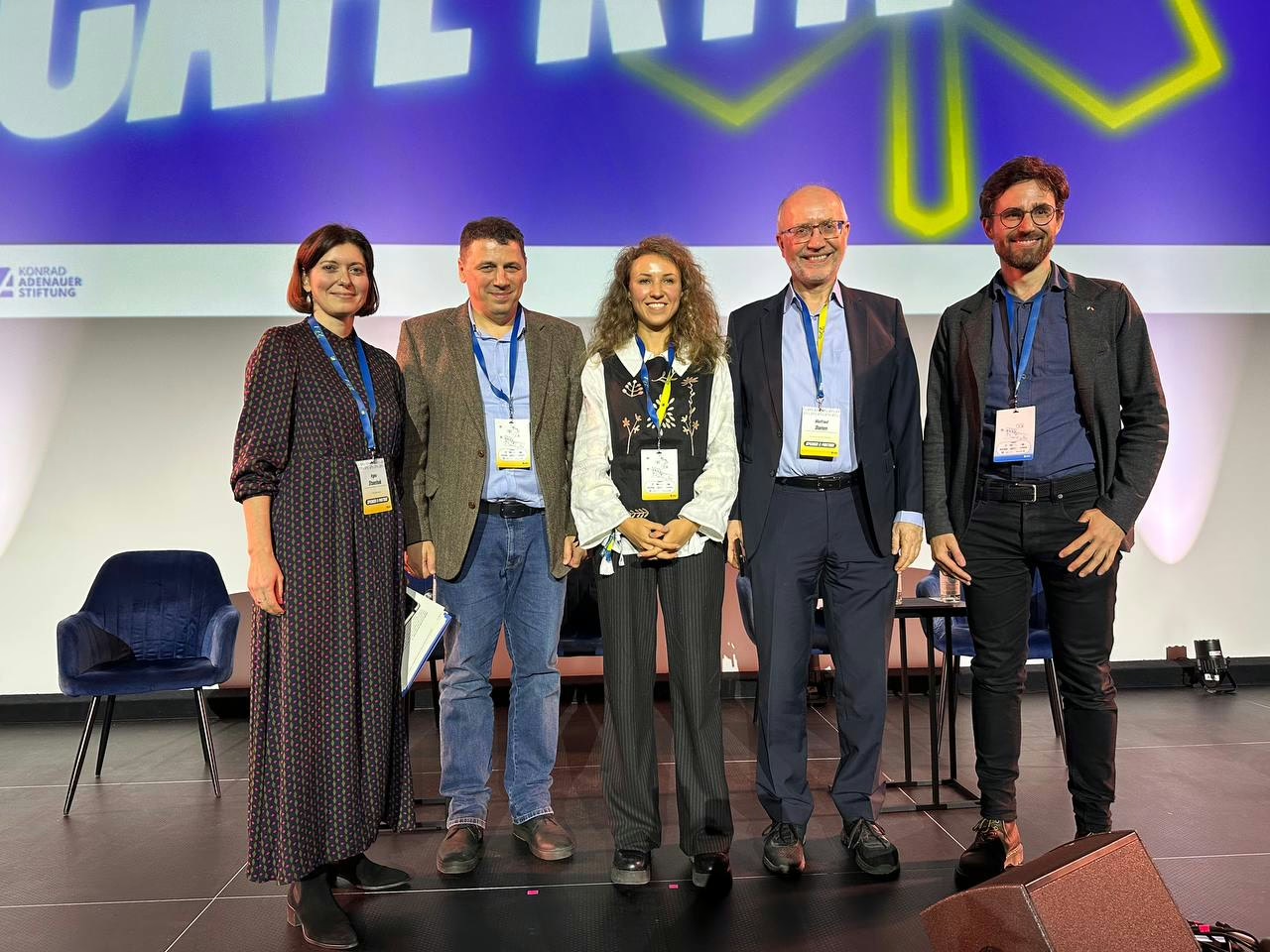
On 23 February 2026, Ecoclub shared practical experience at Cafe Kyiv 2026 in Berlin — a major platform organised by the Konrad Adenauer Foundation and partners, bringing together decision-makers and civil society around Ukraine’s freedom, security and recovery.
One message connects both speeches:
Energy resilience is not abstract. It is whether water keeps running and medical facilities keep operating during outages — including in winter.
What Ecoclub is doing during the war
Ecoclub is an Ukrainian NGO. During the full-scale war, we began providing municipalities with comprehensive project management for building solar power plants to supply hospitals and water utilities.
A significant part of our results comes from helping communities attract grant funding. But the bigger reason is our proactive model: we do not wait passively. We approach local authorities and utilities, encourage them, help them decide, and then support them step by step.
Our current scale (as shared in Brussels):
— 635 municipalities have asked Ecoclub for support
— 86 municipal solar power plants supported in total; 72 solar power plants with battery storage installed so far, prioritising water utilities and medical facilities
— Solar + batteries stabilise critical loads even in winter (generation is lower, but still meaningful; batteries can also recharge from the grid when available)
Solar matters not only because it is clean — but because it is now among the lowest-cost new electricity options, and can be deployed quickly compared to many alternatives.
The bottleneck: Ukraine lacks a proactive national approach
Today, there is no institution in Ukraine that systematically does at a state level what we do on a limited NGO scale: find the best sites, prepare documentation, and structure financing so municipalities can implement quickly.
This gap is now one of the biggest constraints to scaling resilience.
We should find a way how to do the following thing massively now:
- Identify promising locations for solar and other resilience assets (especially at critical infrastructure)
- Support preparation of project documentation (technical design, cost documentation, procurement-ready packages)
- Attract and combine funding sources (grants, blended finance, municipal co-funding, state support, donor programmes)
This “unseen” work — engineering, planning, documentation — is the difference between isolated pilots and national scale.
Lesson from the field: equipment alone is not enough
Our experience shows a clear pattern.
When municipalities have mentoring, templates, ready project & cost documentation, they can:
- mobilise co-funding faster,
- procure more transparently,
- and implement much quicker.
When they don’t, even donated equipment can get stuck for months.
That is why, if we want to scale community energy resilience, we must fund planning, engineering and documentation alongside hardware.
Priority 1: Water utilities — because without water, cities cannot function
If electricity outages are difficult, water outages are catastrophic.
Water utilities are often among the largest single municipal electricity consumers (outside heavy industry). Many have suitable land plots next to key pumping stations, making solar an economically viable option already — and resilience-critical during wartime.
What should be done for water utilities now
1) Demonstrate political leadership
Ukraine should clearly declare support for renewable energy in water utilities — and back it with tools, not slogans. This declaration should include:
– model documentation
– step-by-step roadmap recommended for water utilities deploying solar power plants.
2) Fix the tariff disincentive
Adopt amendments to regulatory acts that eliminate the risk of tariff reductions solely because electricity costs fall due to self-generation — a risk that can discourage investment even when projects are economically rational.
3) Support project and investment documentation for existing financing programmes
Many financing tools already exist, but municipalities struggle to access them because documentation is missing or weak. A targeted support programme for documentation would unlock far more investment than adhoc support for equipment alone.
Priority 2: District heating — an underestimated asset for low-carbon cities
Ukraine’s district heating infrastructure is often undervalued because service quality has been poor for decades. But in reality, it can be a strategic asset that significantly reduces public costs for the transition to low-carbon heating — because it enables large-scale connections of modern technologies.
A strong example is geothermal / ground-source heat pumps connected to district heating. Such systems can provide approximately 3–3.5 kWh of heat per 1 kWh of electricity and operate for decades — a pathway to deep decarbonisation when paired with clean electricity.
Ecoclub is currently trying to introduce the first such geothermal heat pump project in Ukraine, and we found an absurd barrier: the permit fee for drilling can exceed all construction and commissioning costs. Together with a city partner, we developed amendments to legislation to eliminate this barrier, and we hope these changes will be adopted soon.
The deeper issue: municipal capacity and working conditions
Even when technologies are proven and funding exists, municipal capacity remains a bottleneck:
- project development skills,
- procurement competence,
- engineering documentation,
- and stable staffing.
We must keep building capacity through training, mentoring, templates — but we must also make systemic changes that give municipal workers decent working conditions. Without that, municipalities will struggle to retain the people needed to plan and implement modern energy projects at scale.
What we ask partners, donors, and decision-makers to support
If the goal is to scale community energy resilience fast, we should support a full pipeline, not only the hardware:
- Site screening and feasibility
- Engineering design and cost documentation
- Procurement-ready packages and templates
- Mentoring for municipal teams
- Equipment (solar + batteries)
- Commissioning and operational support
Ecoclub is doing this work now — but Ukraine needs a system-level solution that can replicate and scale it nationwide.