












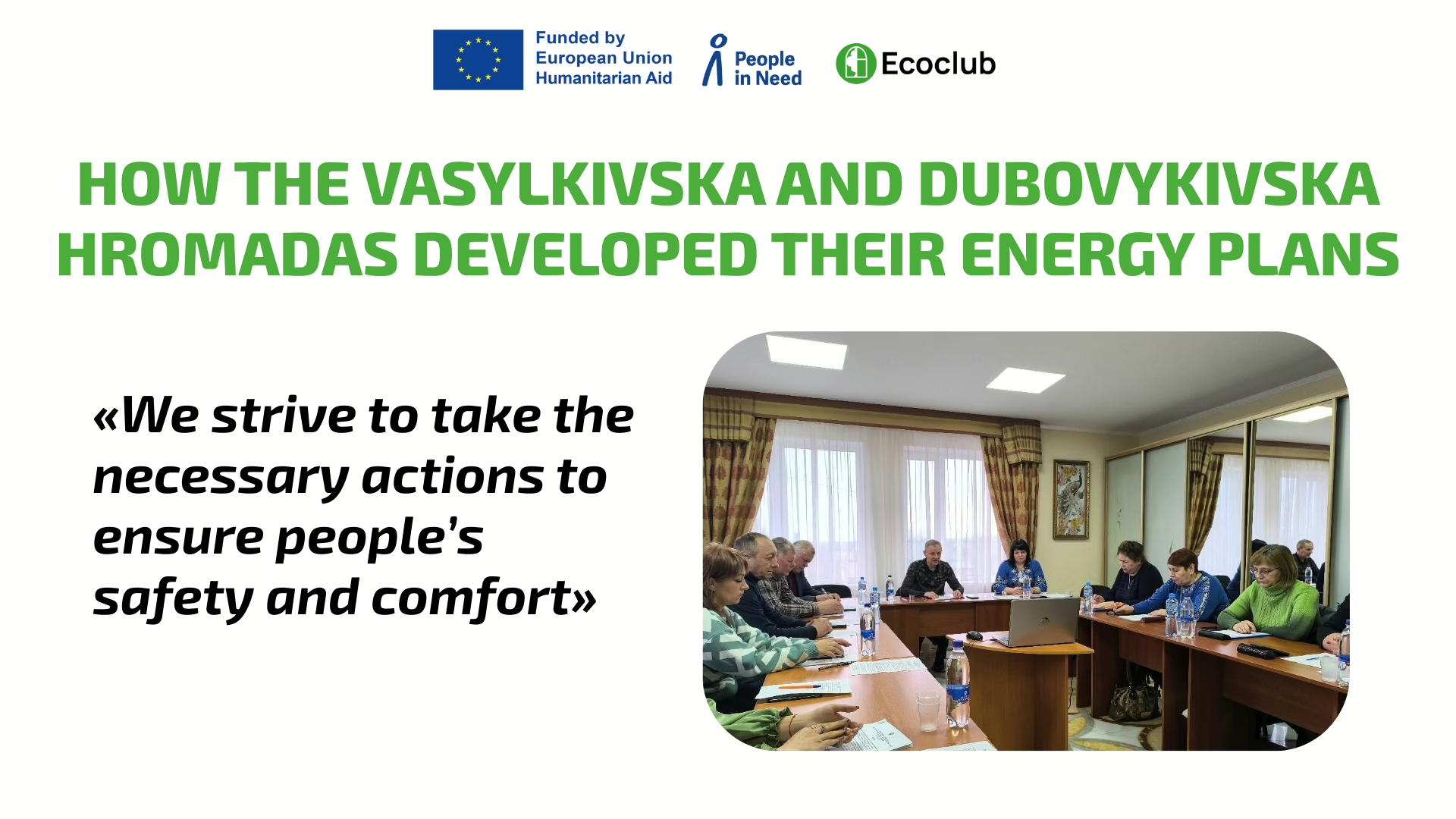
War has pushed Ukrainian hromadas into a state of permanent uncertainty. And yet, planning goes on. Part of that effort means developing a Municipal Energy Plan (MEP) and a Sustainable Energy and Climate Action Plan (SECAP) – practical tools for taking concrete steps toward energy independence.
The Dubovykivska and Vasylkivska hromadas – neighboring territories in the Dnipropetrovsk region – were among the first to go through this process under the project “Support for Winter Preparedness and Renewable Ene rgy at the Local Level in Ukraine,” implemented by the NGO Ecoclub in partnership with the Czech humanitarian organization People in Need, with funding from the European Union.
For both teams, working on energy plans was an eye-opener – a chance to take stock of what their communities actually have and what they can do. Different in scale and circumstances, the two hromadas share one driving goal: ensuring that people have access to water, heat, and light, no matter the conditions.
Dubovykivska Rural Community
Dubovykivska brings together 27 settlements. Despite being located close to the front line – and despite the relentless workload of its staff, from distributing humanitarian aid to inspecting sites of shelling and destruction – the community has chosen structured planning, keeping people’s needs front and center.
In early January 2026, mandatory evacuation orders were issued for families with children in 13 of the community’s settlements, due to the deteriorating security situation. Even so, the local council has not stopped working on critical infrastructure – making sure the basics are covered for those who remain. This kind of planning is about creating a home worth returning to.
Through the project, the community developed a Municipal Energy Plan, with energy security for critical infrastructure as its top priority.
Vasylkivska Settlement Community
Vasylkivska covers 56 settlements. Here, the teams approached planning as a way to make the community’s future more legible – and less subject to guesswork. Working through the documents gave them a fresh perspective on the territory they manage.
The community developed both a Municipal Energy Plan and a Sustainable Energy and Climate Action Plan. In these documents, the Vasylkivska council placed particular emphasis on thermal modernization of public buildings and the rollout of autonomous energy sources.
Rediscovering Their Own Communities
For staff in both hromadas, working on these strategic documents was a genuine professional stretch.
Olha Kozlytska, project manager for the Vasylkivska community, is candid about it:
“I had no background in energy planning at all – and I was genuinely taken aback by how ecologically rich our community turned out to be. When you live somewhere, you stop really seeing it. But once you start analyzing the resources, you find strengths you didn’t know were there.”
In Dubovykivska, staff say energy efficiency was entirely new ground for them too. Tetiana Tokmakova, head of the Land Resources and Housing and Communal Services Department, explains:
“Strategic documents are a fixture in local government, so public consultations and planning procedures were nothing new for me. My background was mostly in land use. Now I can walk someone through picking a convector heater or working out their electricity consumption.”
From Strategy to Solar Panels
Why does planning matter even in wartime? Because it’s the first step toward energy independence – and a direct path to solving real problems now.
Dubovykivska was unequivocal about its top priority: prevent a humanitarian crisis and keep water flowing at all times. The community put this in writing – and has already developed project design documentation for a solar power plant to supply electricity to the local fire station. That same facility is specifically where a new water treatment station is planned to go.
“Getting drinking water delivered is a real problem – no one wants to make the trip out here anymore. Before, we drew water from Pokrovka – that’s no longer an option. “Therefore, our own water treatment station with an alternative energy source, is how we close that gap. It’s not a grand project, but it will make a difference straight away,” adds Tetiana Tokmakova.
Planning in a potential combat zone is extraordinarily difficult when the situation can shift overnight. The measures set out in these documents have to be adapted in real time.
“We live and work in times when the MEP may fall short of its strategic ambitions – but it absolutely delivers for people on the ground. Some measures are simply off the table right now because of the security situation. We push ahead anyway,” the Dubovykivska team says.
The Challenges of Frontline Reality
The conditions under which the work had to be done were the greatest challenge of all. Across all the project hromadas, the most persistent obstacle was a shortage of data – rooted in institutional opacity, a reluctance to share, or simply a failure to understand why the information was being requested. Data collection frequently ended up resembling detective work.
“Finding the data we needed was genuinely difficult. There were times when we simply hit a wall. We sent dozens of letters and showed up in person at institutions, just to piece together the basics,” says Olha Kozlytska.
Staff shortages were another constant obstacle. Many institutions simply don’t have anyone to take on energy planning, let alone data collection and analysis.
The Support That Made It Possible
Producing documents of this scope on your own is a heavy lift for small hromadas operating with limited capacity. The consultations from Ecoclub and its expert partners proved essential in getting them through the process.
The expert support mattered on a technical level and as a driver of the teams’ own professional development. Staff in Dubovykivska recall that meetings sometimes took place on the move – in a car or on the road – because working at a desk in normal conditions wasn’t always possible.
“Your support was extremely important to us. We saw that you were just as passionate about this cause as we were. This gave us the confidence that our efforts were not in vain, but part of a recovery for the sake of the people who believe in their home in the Dnipropetrovsk region,” says Olha Kozlytska, Vasylkivska community.
Takeaways: Building the Future Now
The experience of Dubovykivska and Vasylkivska makes one thing clear: the dangers of war cannot be sidestepped – but thinking about the future is both possible and necessary, even now.
The key reminder is that energy independence is a concrete, measurable undertaking built first and foremost for people.
“On paper, everything looks comprehensive. But in practice, we focus on the smaller, most essential steps – the ones that make a real difference to people’s safety and comfort,” says Tetiana Tokmakova.
The hromadas’ main lesson and advice: don’t wait for the perfect conditions. What’s being done right now is what brings that moment closer. National recovery can start with a single well-written plan – even in the smallest community on the front line.
The content of this material is the sole responsibility of the NGO “Ecoclub” and does not necessarily reflect the views of the partners or the European Union.