












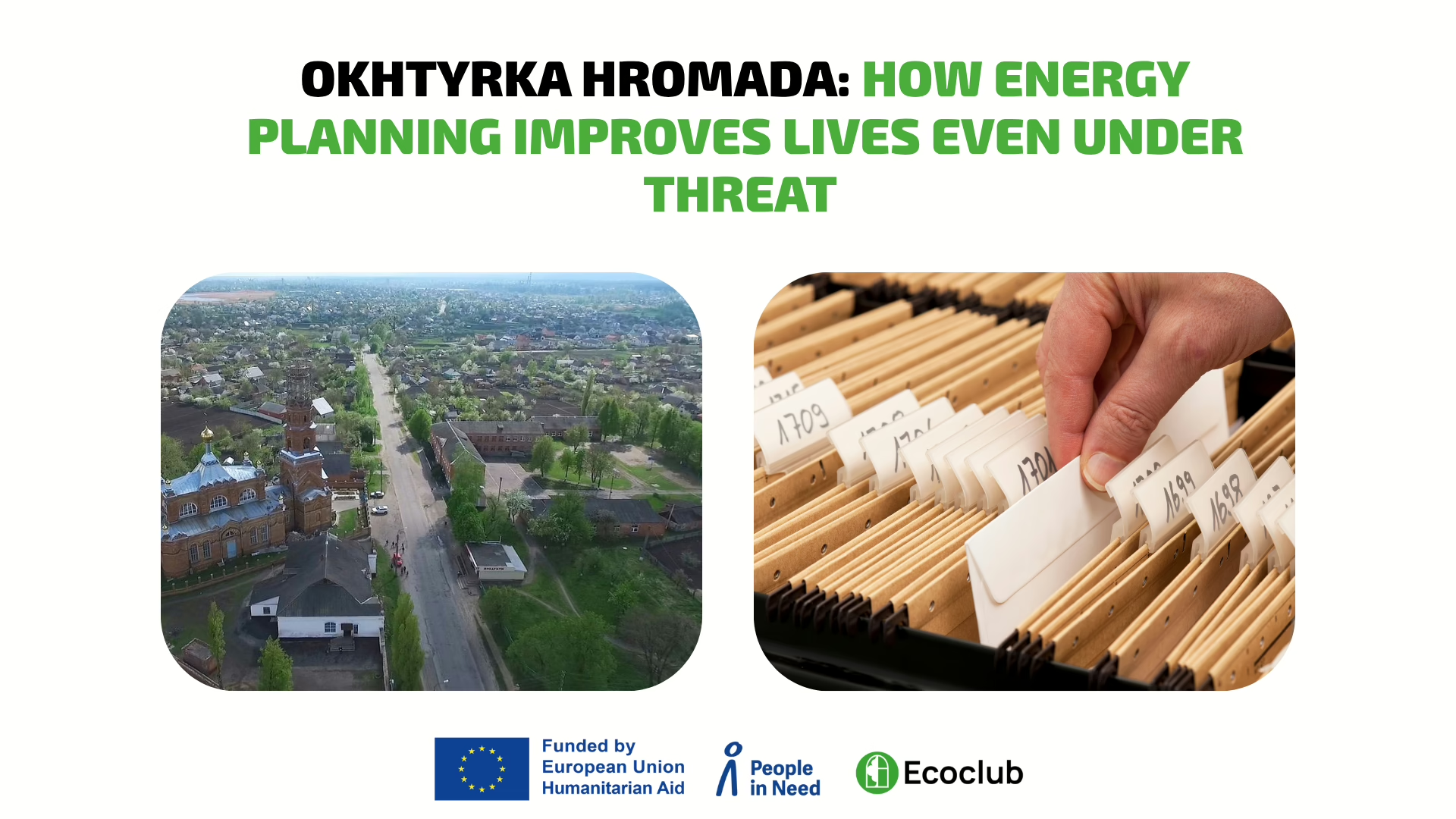
Okhtyrka urban hromada is located 30 kilometres from the border with Russia. In December 2023, it joined the Covenant of Mayors. Following the full-scale invasion, the hromada experienced active hostilities and now faces regular strikes on energy infrastructure and power outages. Against this backdrop, joining the Covenant of Mayors may seem like an unlikely choice, yet local residents see energy efficiency and modernisation as the path to making their border community more resilient — despite the constant risk of destruction.
Two documents instead of one
The hromada worked simultaneously on two strategic documents: the Municipal Energy Plan (MEP), which is mandatory under Ukrainian legislation, and the Sustainable Energy and Climate Action Plan (SECAP), which follows EU approaches.
The MEP is used for national-level planning and reporting, while the SECAP complements it with a climate component. More information on the purpose of the MEP can be found in the article “Municipal Energy Plans: A Simple Guide to What Matters for Every Hromada (UKR)” and on the SECAP — in the article “SECAP for Hromadas: What It Is and How It Differs from the MEP (UKR)”.
Liudmyla Beizym, the hromada’s energy manager, explains the principled decision to develop and adopt two separate documents: “This gives us complete freedom and greater clarity on which document to refer to in each specific case — either the MEP or the SECAP.”
This also avoids duplicating sections and unnecessary questions from the regional level during the approval process. Okhtyrka advises other hromadas to follow their example and prepare these documents separately from the outset rather than merging them into one.
Data collection: the biggest challenge
The practical value of the MEP lies in creating a complete picture of the hromada’s energy consumption. This means data from schools, hospitals, kindergartens, and municipal enterprises. It allows identifying where the greatest losses occur and which measures will have the greatest impact.
One of the most acute challenges in developing the documents was collecting primary energy consumption data. For the document to be well-grounded, relevant data is needed, and the hromada obtained it by every means available. Service providers — electricity suppliers in particular — possess this information but do not always provide it in a convenient format, and in some cases do not provide it at all. This is a typical problem for most Ukrainian hromadas. Okhtyrka’s team notes that baseline data for strategic planning should be more accessible, and that this is a matter of effective cooperation between the national, regional, and local levels.
Despite these difficulties, the hromada managed to collect the necessary information — largely by finding common ground with private organisations and service providers.
The work on the documents was carried out within the project “Support for Winter Preparedness and Renewable Energy at the Local Level in Ukraine,” implemented by NGO Ecoclub in partnership with the Czech organisation People in Need, with the financial support of the European Union. People in Need has been working in Ukraine for over twenty years, and its approach focuses on helping hromadas build systemic resilience: the MEP, in this framework, is the first step; the second is implementing specific energy projects at hromada facilities.
Climate: from abstraction to cycling infrastructure
The climate component of the SECAP proved to be the most difficult to develop. An analytical overview of climate can be produced — the tools exist. But communicating the substance of this work to the community is far more challenging.
Nadiia Pytiukova, Deputy Mayor of Okhtyrka, who worked directly on the climate section, says: “When you tell people about the need to conserve water resources, they are surprised: why conserve them? The same goes for emissions reduction. People understand and respond when they see visible smoke from waste burning. But when you talk about decarbonisation — the abstract link between human activity and climate change — understanding drops sharply.”
Moreover, the city is located in a potential flooding zone, and the argument about conserving water resources is met with particular scepticism here.
That is why the hromada chose an approach based on concrete examples. Okhtyrka has significant road traffic — and when residents are shown that relieving congestion on central streets and developing cycling infrastructure directly reduces emissions, people begin to see the connection between climate policy and the quality of their own lives: air quality, rates of illness, everyday comfort.
Networks that work
“A year ago, I didn’t even know what the word ‘energy management’ meant, and I had never heard of SECAP at all. Now we have open channels on any issue and in any direction,” says Ms Liudmyla.
When the hromada was developing new regulations, the team reached out to colleagues in other cities with a simple request — to share their documents. They readily responded. Having gathered best practices from the experience of several hromadas, Okhtyrka developed its own versions, which have now been formally adopted.
After the project ended, the connections did not disappear: hromadas maintain contact through a shared energy managers’ chat, the Association of Energy Efficient Cities of Ukraine, and direct outreach to one another.
From documents to solar power plants
The results of energy planning in Okhtyrka extended beyond the adoption of strategic documents. In October 2024, there were no solar power plants at the hromada’s municipal facilities. By January 2025, there were five. Three more sets of project design documentation had been developed using local budget funds, and two additional ones were slated for completion in March 2025. An additional impetus came from Ecoclub, which developed project documentation for a solar plant at one of the municipal facilities — this served as financial support at a time when the hromada had neither the funds nor full confidence in the political will for such decisions.
Alongside the rollout of renewable energy, the hromada is implementing systemic changes in governance: an energy policy declaration has been adopted, the energy management regulation has been updated with clearly defined responsibilities for the energy manager in line with current legislation, and an energy management programme has been prepared. All of these documents are interlinked and integrated into the hromada’s development strategy, which is in its final stage of preparation.
Recommendations from experience
Among the practical recommendations the team formulated based on its experience: develop the MEP and SECAP separately and adopt them through separate session decisions; actively engage with other hromadas and exchange documents; allocate sufficient time and resources for primary data collection; use training events not only for professional development but also for building horizontal connections between hromadas.
The experience of the Okhtyrka hromada shows that energy planning is neither a formality nor a reporting obligation. It becomes the foundation for decision-making, implementation of concrete projects, and the gradual development of an energy system capable of functioning even in wartime conditions.
This material was prepared within the project “Support for Winter Preparedness and Renewable Energy at the Local Level in Ukraine” (NGO Ecoclub, People in Need, with the financial support of the European Union).