












Russia’s relentless strikes on Ukraine’s energy infrastructure — combined with the pressures of wartime — have moved energy system transformation from a long-term goal to an immediate necessity.
For over a decade, Ecoclub has focused its work on energy independence and the sustainable development of Ukrainian communities. Today, that focus has sharpened around critical infrastructure: hospitals and water utilities, the facilities that keep essential services running for millions of people.
Both depend entirely on electricity. Without it, water cannot be pumped, treated, or delivered. Keeping the lights on at water utilities is, quite literally, a matter of public safety.
This article looks at how solar power plants (SPPs) are helping water utilities maintain operations even during energy crises. Through the cases of Sumy and Mykolaiv, we explore how these solutions fit within the framework of a just energy transition — and what role community engagement plays in making that happen.
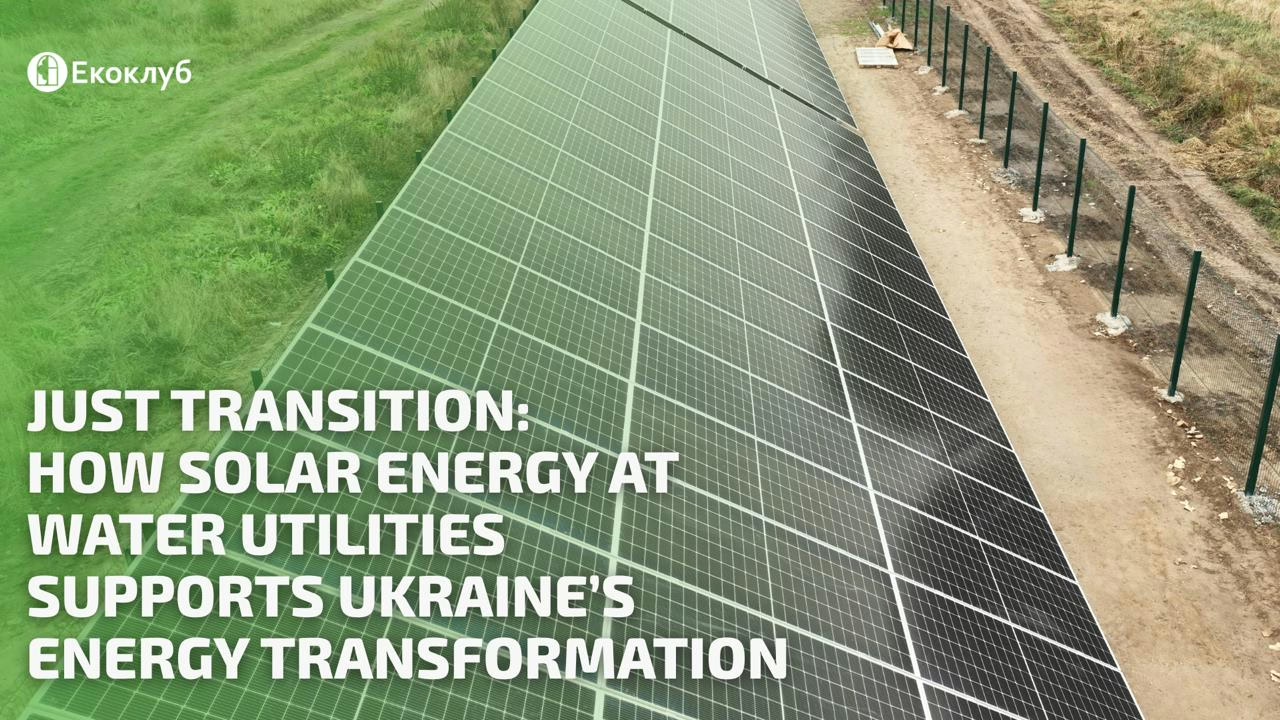
A solar power plant (SPP) brings together several key components: photovoltaic panels, an inverter, cables, fuses, and — where installed — battery storage. The panels capture sunlight and convert it into direct current via the photovoltaic effect; the inverter then converts that current into the alternating current that powers standard equipment.
Put simply: the panels generate electricity during daylight hours, the inverter makes it usable, and the batteries store what’s left over for when the grid goes down.
Access to Water Is a Basic Human Need
Water utilities run on electricity — full stop. Pumping stations, treatment processes, distribution networks: none of them function without a reliable power supply.
Ukrainian water utilities are now operating under conditions that would have seemed unthinkable just a few years ago: sustained attacks on energy infrastructure, the broader disruptions of war, and the compounding pressures of climate change. A halt in water supply during outages poses a risk to people and can lead to a humanitarian emergency. It’s no surprise, then, that decentralized energy generation has moved up the agenda. Installing SPPs at water utilities strengthens their operational resilience and reduces dependence on a grid that can no longer be taken for granted.
Just Transition — What It Means for Ukraine
Just transition is a concept from climate policy. It describes the shift from fossil fuels to renewable energy in a way that distributes the economic, social, and environmental benefits fairly — and ensures that the people most affected by that shift aren’t left behind.
A central concern is workers: those whose jobs disappear as industries decarbonize need pathways into the green economy, whether through new employment or retraining.
But a just transition isn’t only about decarbonization. At its core, it’s about protecting people — their health, their safety, and their access to the basic services they rely on.
Critical infrastructure sits at the heart of that commitment. Ukraine’s experience of large-scale attacks on its energy grid has, paradoxically, created an opening: an opportunity to rethink the country’s energy architecture from the ground up, moving toward decentralized supply and a genuine buildout of renewables.
The conversation at international climate forums tends to focus on headline investment figures and emerging markets. At the level of a water utility, the stakes are more immediate: when a facility can generate its own power, it becomes less vulnerable to grid failures. Residents get reliable water. Municipal budgets absorb lower energy costs. Communities become more resilient. That’s what a just transition looks like when it reaches the ground.
Water Utilities as Anchors of Community Change
«Our first pilot project — installing a solar power plant at a water utility — was completed in 2020, before the full-scale invasion. The aim at that point was straightforward: cut electricity costs and give the facility a degree of energy independence,» says Olena Kondratiuk, Project Manager at Ecoclub.
With backing from the Norwegian Embassy and a contribution from the local budget, a 50 kW grid-connected SPP was commissioned at the Voznesensk municipal water utility in Mykolaiv Oblast.
The results were strong enough that the city kept going — pulling in additional grant funding and committing its own resources until the plant’s capacity reached 350 kW.
In autumn 2022, Ecoclub launched its “Solar Aid for Ukraine” campaign, with the explicit goal of bringing solar energy to critical infrastructure — water utilities and hospitals first.
As of February 2026, Ecoclub had supported the installation of 86 SPPs across the country, 20 of them at water utilities in communities spanning Kyiv, Khmelnytskyi, Poltava, Sumy, Odesa, Mykolaiv, Zhytomyr, Lviv, Ivano-Frankivsk, Chernihiv, Cherkasy, Kharkiv, and Ternopil oblasts. Combined installed capacity stands at 4.4 MW of solar panels and 2,550 kWh of battery storage.
«We’ve also received over 80 requests from water utilities around the country, and prepared preliminary feasibility studies for more than 50 of them. That level of interest tells you something — communities aren’t just asking for help, they’re ready to invest in their own resilience,» says Olena Kondratiuk.
For some communities, solar energy at water utilities has crossed the line from pilot project to standard operating practice — a proven investment with a predictable return. Several cities are now planning new installations funded entirely from local budgets, including Brody, Zvahel, and Zhytomyr.
Sumy
For Sumy — a frontline city — investing in renewables isn’t an abstract climate commitment. It’s a direct response to living under the constant threat of attacks on energy infrastructure.
An SPP has been running at one of the city’s water intake facilities for over a year and a half. Its capacity — 100.57 kW of solar panels paired with 81.6 kWh of battery storage — means the facility can keep operating for 1.5 to 2 hours through a complete blackout. Over its operational life so far, the installation has saved the community approximately 1.5 million hryvnias — funds that can now be redirected toward further energy efficiency improvements.
Sumy has been signed up to the Covenant of Mayors since 2015 and is committed to cutting greenhouse gas emissions by at least 35% by 2030. Fully powering its three water intake facilities and treatment plants would require an SPP capacity of 1.3 MW. The city is actively looking for ways to make that happen — and having seen the technology work firsthand, the motivation is there.
By end of 2025, the Sumy water utility had rolled out SPPs at its other water intake sites. The original installation had proven its worth: under good solar conditions, it could sustain more than 6 hours of autonomous operation — a capability that matters enormously in Ukraine’s current circumstances.
Watch the video about the SPP here.
Mykolaiv
Mykolaiv’s first water utility SPP came online in December 2025 — 36 kW of solar panels and 200 kWh of battery storage.
It was tested almost immediately. During a large-scale strike on energy infrastructure on December 13–14, 2025, the pumping station it serves stayed up without interruption, continuing to supply drinking water to the city for more than 20 hours. In its first 79 days of operation — over winter — the system generated 1,006 kWh, saving close to 10,000 hryvnias.
Watch the video about the SPP here.
Vulnerable communities are already feeling the difference: steadier access to water, lower costs, reduced exposure to wartime disruptions, and new jobs in the renewable energy sector. This is what a just transition looks like in practice.
What Communities Can Do Right Now
Donor funding and government programs tend to move fast — and the communities best positioned to benefit are those that have already done their homework. Here’s where to start:
1) Map your consumption. Understand how much electricity your water supply facilities and other critical infrastructure actually use.
2) Establish your priorities. Which systems need to stay on during an outage, no matter what? What’s the minimum capacity required to keep them running?
3) Build a technical baseline. Pull together the key facts: site data, available rooftop or land area, grid connection options, any protected zone restrictions, existing backup power, and the staff responsible for operations.
4) Run preliminary feasibility calculations. Get a handle on the capacity you need, what it will cost, and what you stand to save. Ecoclub offers an online course on preparing pre-feasibility studies to help communities through this process — learn more here.
How Ecoclub Works with Communities
Project sites are selected through open calls or targeted processes, depending on what donors require. A range of factors shapes which communities are chosen: distance from the front line, population size, technical readiness, and donor criteria. Willingness to engage matters too — the ability to provide technical data promptly, facilitate site access, and commit to long-term operation of the equipment. Not all of these factors are within a municipality’s control. But starting to understand the local situation and run the numbers is something any municipality can do today.
More on our approach to working with municipalities — in podcast here.
One example of this kind of support is our partnership with the Czech humanitarian organization People in Need. The project “Support for Winter Preparedness and Renewable Energy at the Local Level in Ukraine” is funded by the European Union.
The goal is to help war-affected regions restore and strengthen facilities that people depend on — boiler houses, hospitals, and other essential services — by deploying modern renewable energy solutions, so that communities have heat and light even in the hardest conditions.
As part of this project, Ecoclub is supporting the preparation of 15 Detailed Design and Cost Documentation packages (DDCD) covering:
- solar power plants (SPPs);
- energy efficiency upgrades in municipal facilities.
The project helps communities access clean, dependable energy while reducing risks to public health and safety. It lays the technical groundwork for moving away from fossil fuels in a way that doesn’t place the financial burden on local residents.
Conclusion
A just energy transition is about phasing out fossil fuels while making sure people retain access to essential services throughout that process. Critical infrastructure, and water utilities in particular, sits at the center of that challenge: these are the systems that directly determine whether communities stay safe and functional.
Solar energy deployments at these facilities demonstrate that the same solution can be environmentally sound, financially viable, and immediately beneficial to the communities it serves. They build operational resilience, reduce exposure to grid instability, and create the conditions for lasting energy transformation.
The task now is to move beyond individual projects and scale what is already working. With the right combination of technical preparation, community readiness, and coordinated support from government and donors, renewable energy can become a cornerstone of Ukraine’s recovery — and its future.