












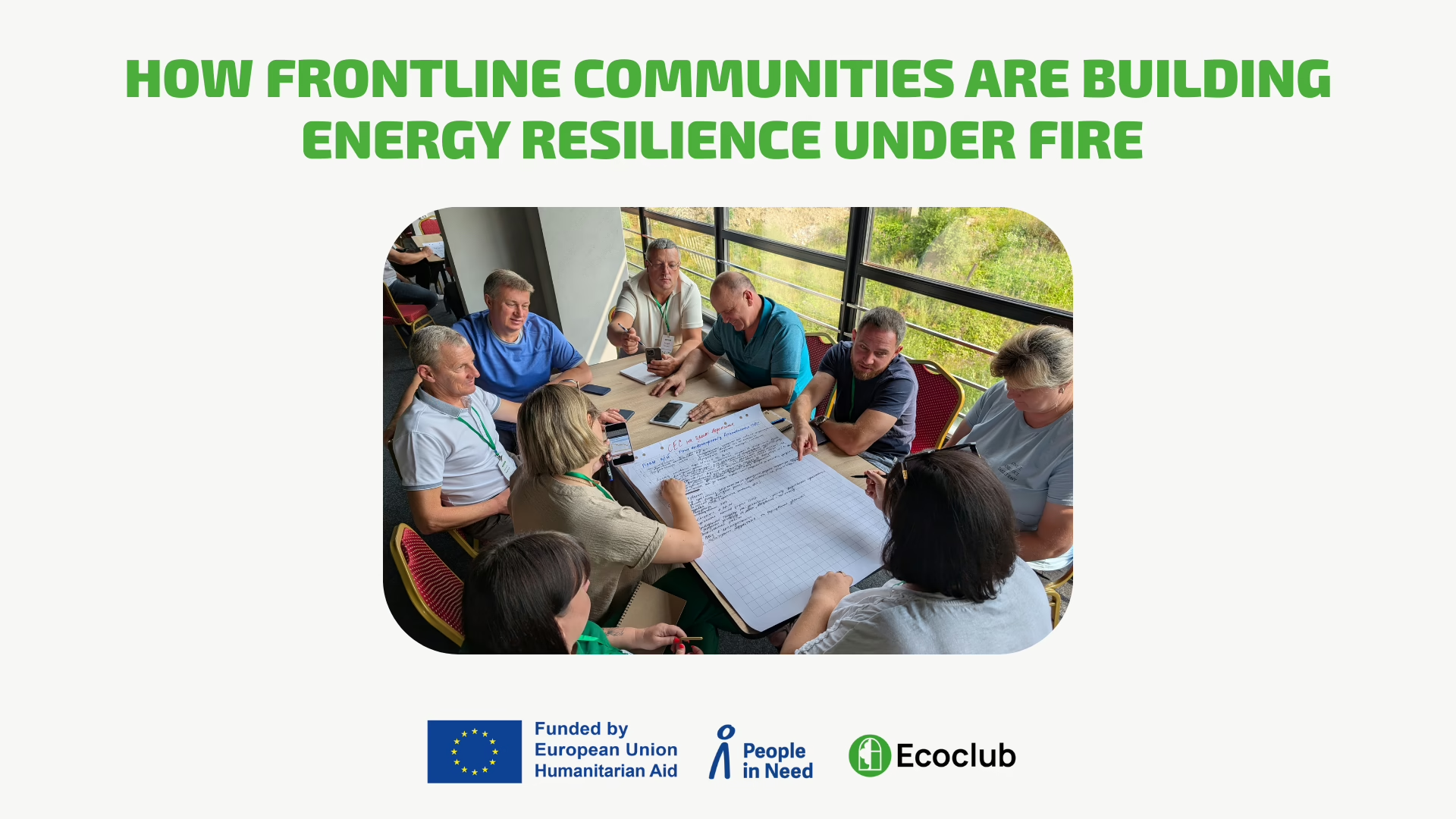
The development of Municipal Energy Plans (MEPs) is a legal requirement for all Ukrainian communities. However, the pace and approach to this work vary significantly. Today, more and more hromadas (communities) see energy as the foundation of their security and ability to endure, integrating these solutions into day-to-day planning.
Hromadas in the Sumy and Dnipropetrovsk oblasts, within the reach of enemy artillery, are forced to make decisions quickly and pragmatically. For them, energy resilience is not an abstract goal but a condition for daily functioning: the operation of hospitals, water utilities, boiler houses, and communications. Their experience shows that even under severe security constraints, it is possible to move from reactive measures to systematic planning.
For many Ukrainian communities, the war has pushed life into a state of constant instability– moving from one power outage to the next. While this has increased general attention to energy systems, the lack of a clear vision has become a critical risk specifically in frontline regions. Here, energy planning directly affects a community’s ability to maintain basic services and operate with limited resources.
Planning as a necessity
The Znob-Novhorodska hromada in Sumy oblast is located in the immediate vicinity of the combat zone. Constant shelling and power-supply interruptions are part of daily life. Despite this, the community was among the first to develop and approve its Municipal Energy Plan.
In peacetime, such documents were often postponed due to a lack of time or resources. In wartime, the cost of delay has escalated. When electricity is unavailable, water pumps stop, communications fail, and risks increase for hospital patients. As a result, communities are forced to take a closer look at available resources, set priorities, and seek solutions that deliver the greatest impact.
The MEP as a working tool
A Municipal Energy Plan (MEP) is not paperwork for reporting purposes. It’s a clear, usable picture of a community’s energy use – how much is consumed and by whom, which facilities are critical, where losses are greatest, and which actions can strengthen the reliability of essential infrastructure.
For donors and partners, a MEP also signals a community’s capacity to work with data and plan ahead. Having such a plan simplifies needs assessments, reduces uncertainties, and increases the chances of securing support for specific, well-calculated solutions.
A project implemented by Ecoclub, in cooperation with the Czech humanitarian organization People in Need and with financial support from the European Union, covered 16 communities in the Dnipropetrovsk and Sumy oblasts. Its goal is to help communities transition from isolated fixes to a systematic approach to energy management. Over three months, experts collected consumption data, analyzed the state of networks, and assessed the potential for local generation – ranging from solar energy to the use of biomass and waste.
The outcome was not only analysis, but also a practical tool: a list of specific solutions with calculated budgets that communities can use for planning and attracting funding.
Working amid constant adaptation
The Vasylivka settlement community and the Dubovykivka village community in Dnipropetrovsk oblast were the first to complete their MEPs. Zelenodolsk, which frequently appears in frontline reports due to shelling, also emerged as a leader.
The preparation of these plans took place under difficult conditions: work was interrupted by air-raid alerts and the need to address the consequences of attacks; some specialists had evacuated, increasing the workload on the remaining local teams; and power-outage schedules forced teams to adapt their work to the hours when electricity and internet were available.
At the same time, these conditions clearly highlighted the need to increase the reliability of critical infrastructure. Local generation – particularly hybrid solar power plants with battery storage – allows hospitals, water utilities, and other facilities to operate autonomously even during a total grid blackout. Basic safety of residents is under consideration rather than their comfort.
From plans to implementation
The analytical groundwork of the Municipal Energy Plans is now moving into the next, practical phase: the preparation of design and estimate documentation. Together with the communities and engaged experts, Ecoclub is developing technical solutions for facilities prioritized by the communities based on security and service continuity.
Based on the MEPs, design, and estimate documentation is currently being developed for the following solutions:
- 4 solar power plants for water supply facilities;
- 2 solar power plants for hospitals;
- 1 solar power plant for a fire station;
- 2 solar power plants for educational institutions;
- thermal modernization of 2 hospitals;
- thermal modernization of a kindergarten;
- modernization of heating systems for a cultural centre and a hospital.
Preparing design and estimate documentation is a critical stage: it allows communities to move from planning to seeking funding and subsequent implementation without losing time or quality.
Priorities over preaching
Frontline communities show that energy planning remains possible in the most challenging environments. In practice, this planning translates into pragmatic, workable decisions that keep community life running and do not depend on perfect strategies.
Their experience confirms that a systematic approach to energy helps communities use available resources more effectively and stay prepared for crises. These local solutions, replicated and scaled across places, strengthen the country’s overall energy resilience.
This material was prepared as part of the project “Support for Winter Preparedness and Renewable Energy at the Local Level in Ukraine,” implemented by Ecoclub in cooperation with the Czech humanitarian organization People in Need and with financial support from the European Union. The content of this material is the sole responsibility of Ecoclub and does not necessarily reflect the views of the partners.