












The Sambir community is actively working to improve the comfort and quality of life of its residents. A key step in this direction is a revolving fund — a financial support mechanism for residents of apartment buildings. Through this mechanism, apartment building co-owner associations (OSBBs) will be able to receive funding to implement energy efficiency measures and deploy renewable energy solutions — generating savings that can later be redirected to other needs.
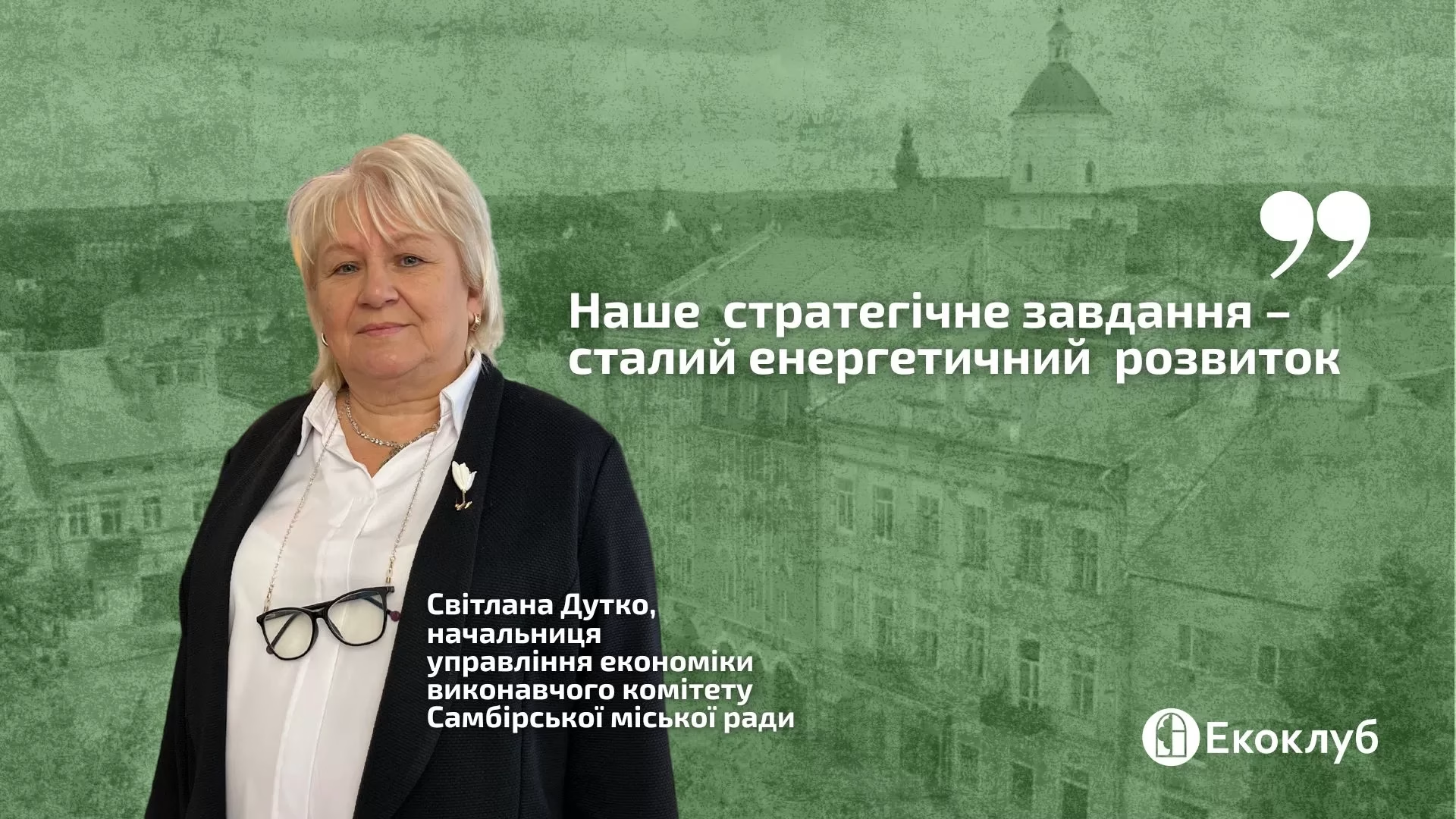
How will the financial mechanism work? What will the participation conditions be? We spoke with Svitlana Dutko, Head of the Economy Department of the Executive Committee of Sambir City Council.
Svitlana, could you briefly tell us about your community?
Sambir Urban Territorial Community consists of the city of Sambir and four rural settlements. The total population is 37,973 — the majority living in the city, with around 3,000 in the rural part of the community.
Could you tell us how your community is moving toward sustainable development and what it means to you?
We have development strategies in place, where a clean environment, modern infrastructure, and renewable energy sources are among the key goals. Our strategic objective is sustainable energy development. Sambir is a signatory to the European Commission’s Covenant of Mayors initiative. That is why we have a Sustainable Energy and Climate Action Plan (SECAP) through 2030. We are also currently developing a municipal energy plan.
The strategy includes a number of energy-related programmes, as well as several projects we plan to implement by 2030: thermal modernisation of buildings, rollout of renewable energy sources, and adoption of sustainable energy measures. All of this will help reduce energy consumption and cut costs for the community.
What specific steps is the Sambir community taking now?
The first step, as I mentioned, is the thermal modernisation of buildings: replacing windows, doors, and roofs with more energy-efficient ones. During power outages, critical infrastructure kept running with the help of diesel generators to ensure uninterrupted power supply. But this is an expensive solution. So we realised we needed another alternative to ensure continuous electricity supply.
For example, this is especially relevant for the hospital, which has an intensive care unit, a surgical unit, and an admissions department. If a patient is in critical condition and the generator lacks the capacity, a solar power plant (SPP) can ensure uninterrupted power. Doctors will be able to work more steadily in critical conditions, and patients will continue to receive care without interruption.
Do you still use diesel generators?
Diesel generators are an expensive solution: they require constant maintenance and can break down at any time. We have several generators through our partnership with UNICEF. We are now actively looking for funding to install an SPP on the roof of the central hospital and at other facilities. The local water utility has the same need. In critical situations, an SPP would guarantee continuity of operations, so residents would continue receiving water supply and wastewater services.
Do you involve residents in implementing sustainable energy measures?
As a signatory to the Covenant of Mayors, the city of Sambir holds Sustainable Energy Days, running information campaigns as part of them. For example, one of the schools has a demonstration classroom where children learn how renewable energy sources work. Teachers also have books on energy efficiency, energy saving, and a clean environment.
Educational activities are held in kindergartens, where children learn the basics of energy saving. Another example is a pavement drawing competition, where children illustrated energy-saving measures. We also work with schools.
Of course, we involve adults as well, but children are our future. And it matters to us that we invest in their values from an early age.
Tell us about the financial mechanism you are creating. Who will use it?
As part of the project “Strengthening Climate Action in Ukrainian Communities,” we plan to introduce a revolving fund. The fund will provide interest-free repayable support to OSBBs for implementing energy efficiency (EE) and renewable energy (RES) measures.
We are promoting the importance of creating OSBBs among residents, so that apartment buildings can access repayable financial support. Residents of multi-apartment buildings often cannot afford renewable energy and energy efficiency measures, and they are reluctant to apply for bank loans. Our mechanism is about giving them security and confidence.
The fund will be replenished with money that apartment building co-owners pay back. In other words, the recipient saves on energy costs and gradually returns the funds to the pool. The repaid money is then used to finance new projects.
We are now looking for ways to increase the fund’s inflows so that more OSBBs can receive assistance.
Will you initially use local budget funds to set up the fund?
Yes. We are still at the establishment stage, so we are not considering grant initiatives yet. Together with Ecoclub experts, we are developing the operating mechanism.
I want to stress that initially, funds from the city budget are earmarked for specific works. Residents of apartment buildings carry out those works, save money, and then return the funds.
What benefit will this financial mechanism bring to the community?
The benefits are clear: a cleaner environment, energy savings, reduced costs, and sustainable energy development. If we want to reduce emissions and improve the well-being of our residents, we need to involve them in sustainable energy measures.
There are OSBBs that already work with the Energy Efficiency Fund, but unfortunately they are still a minority. Through this mechanism, we want to show that creating an OSBB is important.
Are there other financial support options for OSBBs?
There used to be a micro-project competition for OSBBs, financed from the regional budget, with the city budget providing a non-repayable co-financing contribution. This programme no longer runs under wartime conditions. That is why it is important for us to create a mechanism that will work in today’s realities — and that people will actually use.
Was that mechanism actively used?
In fact, we expected more activity from OSBBs, but the war has disrupted Ukrainians’ plans and priorities. That is why, alongside the creation of this mechanism, communication will play an equally important role. We plan to promote the benefits of the revolving fund — and the value of forming OSBBs — among residents, drawing on examples from other communities.
Do you already have ideas about the conditions for participation?
We hope to receive many applications, so for now we plan to award funding on a competitive basis. We will sign agreements with potential participants — everything fair and transparent.
What changes do you expect after the mechanism is introduced?
Our aim is to encourage more OSBBs to form, because this is the only way residents can access funding to implement energy efficiency measures — which in turn means savings on energy costs, reduced harmful emissions, and improved well-being for residents.
The project is supported by the IKI Small Grants programme, part of the International Climate Initiative (IKI). IKI Small Grants is funded by the Federal Ministry for Economic Affairs and Climate Action (BMWK) and the Federal Foreign Office (AA) and implemented by Deutsche Gesellschaft für Internationale Zusammenarbeit (GIZ) GmbH.