











The Drohobych community in Lviv region has been working for several years toward energy independence and greater resilience. The community was selected as one of the ten finalists of Ecoclub’s competition “Strengthening Climate Actions in Ukrainian Communities.”
As part of the project, working alongside Ecoclub experts, Drohobych is developing a financial tool that would allow households, OSBBs, and housing cooperatives to offset the cost of installing solar power systems. This would lower utility bills and improve residents’ well-being.
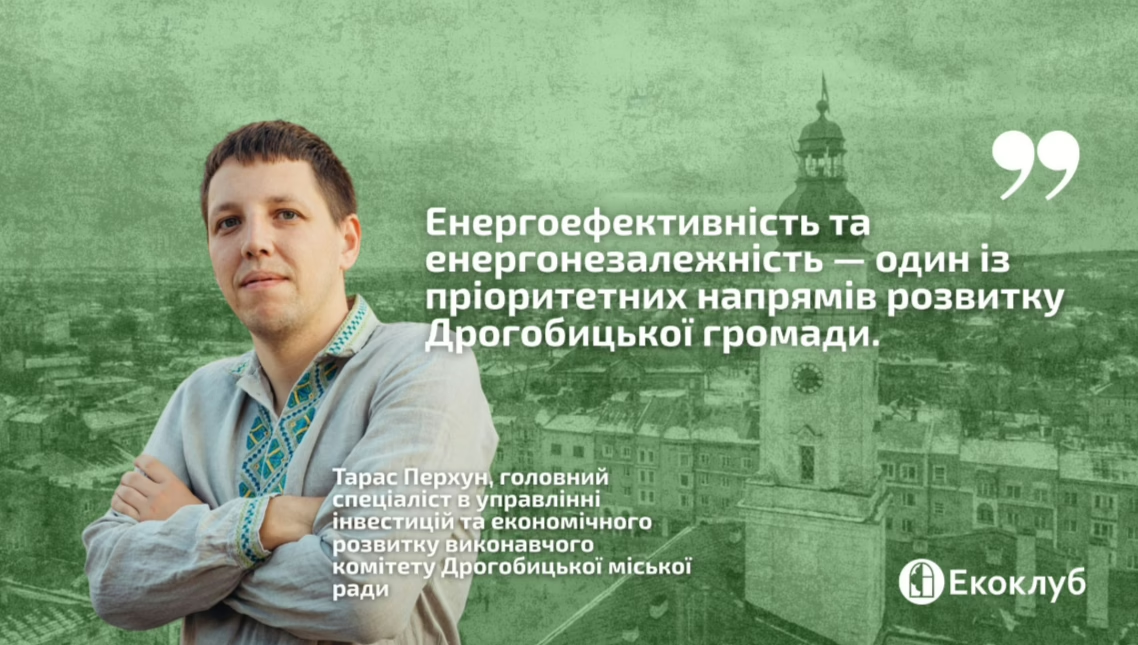
Drohobych also has a chance to receive up to €10,000 to implement the mechanism. We spoke about how it would work and what it could mean for the community’s sustainable development with Taras Perkhun, Chief Specialist at the Department of Investment and Economic Development of the Executive Committee of Drohobych City Council.
Taras, could you briefly tell us about the Drohobych community?
Drohobych Urban Territorial Community is one of the largest communities in Lviv region by population. As of the beginning of 2022, more than 120,000 people lived here. After the full-scale invasion, the population declined, although the situation has partly stabilised thanks to internally displaced people. Today, we have around 7,000 officially registered IDPs.
The community is home to many farms, as well as a municipal enterprise that raises cattle and sells dairy products. Other key employment sectors include light industry, especially garment production, and the pharmaceutical sector.
What are the main energy challenges facing the community today?
The biggest challenge is ensuring the continuous operation of critical infrastructure after the massive attacks in 2022. This includes water supply, heat supply, and healthcare facilities. We managed to equip some of these sites with diesel generators, but this is only a temporary solution: it depends on fuel availability and also pollutes the environment.
Today, our main task is to find a sustainable way to supply energy to enterprises such as the municipal utility Drohobychvodokanal, the municipal utility Teploenerho, and Drohobych City Hospital No. 1, which serves the entire southern part of the region.
What exactly do you mean by the “uninterrupted” operation of infrastructure?
We mean round-the-clock, uninterrupted operation of equipment, especially in hospitals and at the water utility. This includes, for example, X-ray and MRI machines, surgical suites in healthcare facilities, and pumps at the water utility. To ensure continuity of power supply, we are considering hybrid solar power plants, heat pumps, and possibly solar collectors for hot water supply.
Does your community have an energy management system? What results has it produced so far?
At the moment, our energy management system is still being developed. We do not yet have a fully-fledged department, but responsible officers have been appointed in the main sectors: education, healthcare, culture, and housing and communal services. The education department has a dedicated energy manager, and since January 2024 an energy manager position has also been introduced within the structure of the executive committee.
We also carry out energy monitoring. All municipal institutions regularly submit their energy consumption data to the uMuni system, which we have been using since 2017. This data allows us to analyse efficiency and plan energy-saving measures.
Why did the community decide to create a financial mechanism to support energy efficiency?
In 2021, we approved the Community Development Strategy, in which energy efficiency and energy independence are among the key priorities. In 2019, the city of Drohobych also joined the European Commission’s Covenant of Mayors initiative and committed to cutting greenhouse gas emissions by 30% by 2030.
To achieve these goals, we are creating support mechanisms to help residents and OSBBs implement energy-efficient solutions. Energy efficiency and energy independence are among our community’s development priorities because they directly affect the comfort and well-being of our residents.
Has your community developed a SEAP or SECAP?
Yes, we have a SECAP, a Sustainable Energy and Climate Action Plan through 2030. It includes climate change adaptation, because today this is impossible to ignore.
In 2023, we submitted an interim monitoring report on emissions reductions. We managed to achieve a 10.5% reduction.
What measures helped achieve this reduction?
It was a comprehensive effort. First of all, in the residential sector, this meant comprehensive thermal modernisation of buildings.
We started back in 2015 under the EU/UNDP project “Community-Based Approach to Local Development.” In 2015–2017, two buildings were fully modernised.
Later, we began working with the Energy Efficiency Fund. In addition, we implemented smaller projects in around 26 OSBBs, including roof, window, and door replacements. The community also actively participated in the Lviv Oblast Local Initiatives Competition. These were projects worth up to half a million hryvnias, focused on capital repairs of buildings, such as replacing windows, doors, roofs, and so on. Over the past 10 years, we have also installed 10 heat pumps.
What financial support mechanism exactly do you plan to implement?
We already have an active municipal target programme called “Solar City,” which covers part of the cost of energy-efficient equipment for private households and OSBBs, including solar power systems, heat pumps, and individual heating substations.
The new idea is to double the available funding through participation in this project. For example, if the city allocates half a million hryvnias and our partners provide the same amount, we will be able to support twice as many households and increase the share of renewable energy generation in the community.
How will the reimbursement work? For example, do residents install a solar power system at their own expense, and then the city council compensates a certain percentage?
Yes, 25% of the equipment cost.
Does this apply to private houses and OSBBs as well?
Yes, it applies to private houses, OSBBs, and housing cooperatives. We have different forms of multi-apartment building management. The most common are OSBBs and property management companies, such as ZHEOs, formerly known as ZHEKs. Today, they are certified and officially manage buildings, and there is even competition among them.
What about municipal institutions?
Yes, there are solutions for them as well. For example, a solar power plant has already been installed on the surgical building of the hospital. Before that, the building underwent full thermal modernisation: the roof was replaced, and the attic and façade were insulated. This was done with funds from the city and regional budgets under the “Energy Saving 50/50” programme.
In 2022, we also installed a heat pump in a kindergarten, again with 50/50 co-financing from the regional budget.
We are now working with grant funding. For example, with GIZ support, municipal energy plans are being developed as part of a project promoting the implementation of the EU Energy Efficiency Directive.
What changes do you expect after this financial mechanism is introduced? Perhaps the number of solar power plants in the community will increase, or, say, 50% of energy supply will come from solar power?
We always aim for the best possible result. But there are several key expectations. First, we want people to take advantage of the opportunities available to them and become more energy independent. This is especially important now, when it is difficult to predict how long the war will last. If power outages return, community residents will be the first to suffer. That is why we want people to be better protected.
And, of course, we want to increase the share of green energy, since we have relevant commitments, including under the Covenant of Mayors.
The project is supported by the IKI Small Grants programme, part of the International Climate Initiative (IKI). IKI Small Grants is funded by the Federal Ministry for Economic Affairs and Climate Action (BMWK) and the Federal Foreign Office (AA) and implemented by Deutsche Gesellschaft für Internationale Zusammenarbeit (GIZ) GmbH.