












Koziatyn community is gradually building a support system for energy-efficient solutions – from strategic planning to financial mechanisms for apartment building co-owner associations (OSBBs). One of the first steps was the launch of a revolving fund, which lets residents of apartment buildings implement energy efficiency projects now, rather than postponing them for lack of funds.
The community brings together 16 settlements, with its administrative centre in the city of Koziatyn. It is often described as a logistics hub owing to its important railway junction, and the local economy relies heavily on the railway. This encourages local authorities to look for new approaches to development, including through energy transformation.
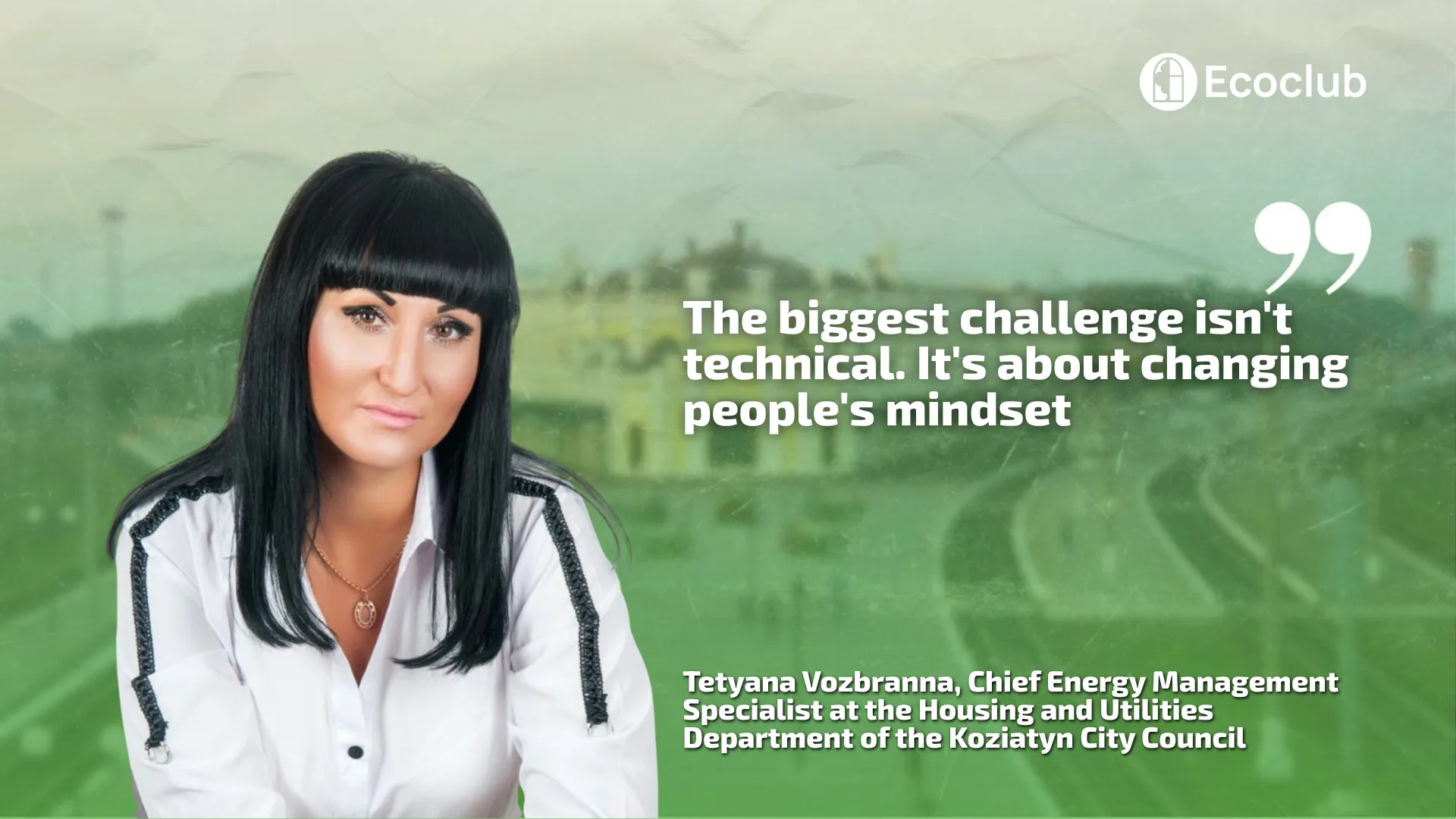
Tetiana Vozbranna, Chief Energy Management Specialist at the Housing and Communal Services Department of Koziatyn City Council, explains how the community is introducing energy management, why it chose a revolving fund for OSBBs, and what challenges it has faced.
Sustainable Development in the Community
Our community was established in 2020, and since then we have been working systematically on its development. In 2021, we approved our development strategy through 2030, and we are now updating it to reflect new challenges, especially in energy and climate.
In 2024, we approved the Sustainable Energy and Climate Action Plan (SECAP) through 2030. We are now developing a Municipal Energy Plan and a Green Recovery Plan, which we are preparing together with international partners.
For us, energy independence is the goal. We approach it comprehensively: from the thermal modernisation of buildings to the modernisation of water supply, wastewater and waste management systems.
How Energy Management Emerged in the Community
This work began in 2021, when we applied to participate in a UNDP project. At that time, we were working on setting up automated energy monitoring for public institutions, including tracking energy consumption in schools, kindergartens, hospitals and administrative buildings.
When I joined the team, the process had already been launched, and we began actively putting it into practice. Over time, this grew into the creation of a full energy management system: we developed the necessary documents, adopted executive committee decisions, and installed equipment at the facilities. Today, the system is almost fully operational. We only need to complete the connection of a few facilities and meters, after which we will move on to full-scale testing.
The biggest challenge is not technical. It is a cultural one – changing people’s mindset. We do not yet have a fully ingrained culture of energy efficiency. That is why we sometimes have to explain basic things: energy efficiency is not about reducing consumption at any cost. It is about creating comfortable conditions in institutions while using resources wisely. It is not about cutting consumption at the expense of quality, but about saving through proper resource management.
The Revolving Fund for OSBBs as an Energy Efficiency Mechanism
As part of Ecoclub’s project “Strengthening Climate Action in Ukrainian Communities,” we launched a revolving fund aimed at supporting OSBBs. The community has about 33,000 residents, most of whom live in apartment buildings. Around 150 OSBBs have been established here, and they are the ones that can be among the first to implement energy-efficient solutions, because this would have the greatest impact for the entire community.
Despite the clear advantages, the financial capacity of residents remains the deciding factor. Energy efficiency measures are expensive, and most OSBBs simply cannot fund them on their own. Their budgets are mostly spent on basic needs – building maintenance and routine repairs.
That is why we were looking for a mechanism that would help OSBBs take the first step without waiting for the full amount. The revolving fund makes this possible – energy efficiency measures can be launched even when full financing is not available at the start.
How the Fund Works in Practice
So far, there is one completed case – the OSBB “Lokomotyv 42.” They received funding for roof repair combined with insulation.
We kept the procedure as simple as possible: a minimum of documents and quick decision-making. Once approved, the funds can be transferred as early as the next day. This is a major advantage, especially now, when speed and accessibility are critical for initiatives like this.
In the near future, we plan to top up the fund regularly. There is already an understanding that the funding needs to be increased to UAH 500,000 or even UAH 1 million. This would allow us to bring in more OSBBs and scale up the mechanism. Importantly, we already have a successful example, so we believe more and more associations will want to use it.
How This Connects with Other Programmes
We do not see the revolving fund as a separate mechanism. It is part of a broader system of energy efficiency support in the community.
Our goal is to link it with state and international programmes, in particular the Enerhodim and GreenDIM programmes of the Energy Efficiency Fund. These programmes operate on a co-financing model, and we see an opportunity to use the revolving fund to cover part of the OSBB contribution.
This is how a combined model takes shape: the state provides support through programmes, local authorities add a financial mechanism, and OSBBs themselves participate as active stakeholders. The result: less financial pressure on all sides and more accessible, scalable energy efficiency projects.
The Challenges We Faced
The biggest challenge was convincing all the decision-makers that this mechanism was truly needed.
For a long time, the familiar approach was: approve the budget, spend the funds during the year, then report. This is a completely different model – funds are not simply spent but returned and put to work again for the benefit of the community.
So we had to spend a lot of time explaining the logic of the revolving fund, holding meetings with council members, showing examples from other communities, and proving that this mechanism works.
The decision to allocate funding was also a difficult stage. We had to convince people that this was not a one-off initiative, but a mechanism that could deliver over the long term. In the end, we were heard, and the fund got off the ground.
The Impact on the Community
When we talk about impact, the bottom line is always the same: improving people’s quality of life.
Under current conditions, it is especially important for homes to have light and heat. These are basic things that determine residents’ comfort and safety.
Ultimately, this creates a comprehensive effect: resource consumption decreases, the burden on the community budget is reduced, and the environmental situation improves.
Advice for Other Communities
The advice is simple: start small and don’t be afraid to. At first, the mechanism may seem complicated, but its value becomes clearest in practice.
It is important to keep learning, adopt the experience of other communities, and implement proven solutions locally. Training events, projects and meetings focused on energy efficiency and energy independence are very helpful in this regard. They provide access not only to resources, but also to knowledge, contacts and a clearer understanding of the overall direction in which the sector is developing.
Another important point is not to try to do everything at once. In this sense, a revolving fund is precisely the first but very important step. It launches the process and makes it possible to gradually build the system further.
The project is supported by the IKI Small Grants programme, part of the International Climate Initiative (IKI). IKI Small Grants is funded by the Federal Ministry for Economic Affairs and Climate Action (BMWK) and the Federal Foreign Office (AA) and implemented by Deutsche Gesellschaft für Internationale Zusammenarbeit (GIZ) GmbH.