












The Myrhorod community has adapted its existing Myrhorod Entrepreneurship Support Fund to help local businesses stay operational during power outages. The fund has been active in the community since 2001 and has traditionally supported the development of small and medium-sized enterprises.
In response to energy challenges, the fund expanded to cover alternative energy solutions, including inverters and batteries.
The fund operates on a revolving basis: entrepreneurs receive 0% financing for a defined period, implement the solutions they need, and gradually repay the funds. These same resources are then used to support other businesses that pass a competitive selection process.
This approach allows the community not only to respond to a crisis, but also to put in place a sustainable support mechanism that drives long-term local development.
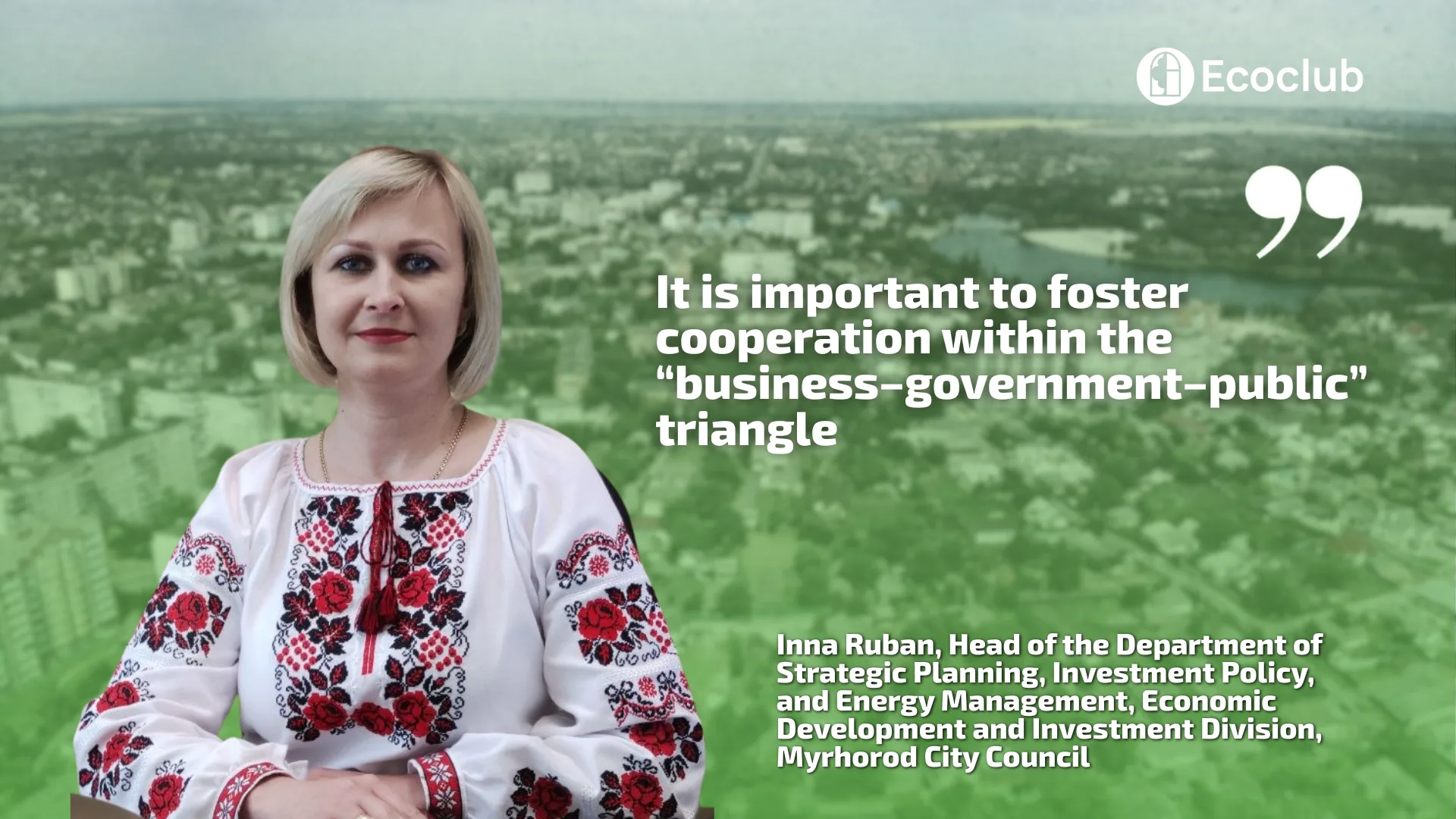
Inna Ruban, Head of the Department for Strategic Planning, Investment Policy and Energy Management at the Economic Development and Investment Directorate of Myrhorod City Council, explains how the idea came about, how the mechanism works, and what results it has already delivered.
Sustainable Development in the Community
The Myrhorod community follows a systematic development path guided by strategic documents. In 2020, the community approved its Sustainable Energy and Climate Action Plan (SECAP) through 2030, which set out specific commitments to reduce CO₂ emissions.
In 2025, the community also adopted its Municipal Energy Plan (MEP), which further spelled out these commitments, including a 17.03% reduction in energy consumption and a 5.9% increase in the share of renewable energy sources. At the end of the same year, the community also updated its development strategy through 2030.
Why the Fund’s Approach Needed to Change
The trigger was the mass power outages and the first blackouts across the country. It quickly became clear that neither the municipal sector nor businesses could operate reliably without alternative sources of energy.
At the same time, another problem surfaced: businesses located on the ground floors of residential buildings were relying heavily on generators. Power could be out for several hours, and residents effectively had to live with constant noise throughout. This caused social tension and complaints.
We understood that business is the backbone of the community’s development, but we could not ignore residents’ quality of life either. So we needed to find a solution that would strike the right balance between these interests.
Why We Decided to Support Businesses Specifically
We held coordination meetings with entrepreneurs through the advisory body. These meetings gave us direct access to the problems businesses were facing. At the same time, we considered the possibility of supporting apartment building co-owner associations (OSBBs), but our analysis showed that state and international programmes already exist for them, including GreenDIM and SvitloDIM, which allow them to attract funding independently.
This further reinforced our decision to focus specifically on supporting businesses. After consultations with OSBB representatives — who also backed the idea — we were fully convinced this was the right call.
How the Fund Works After the Changes
We did not create a new mechanism from scratch. Instead, we took an existing one — the Myrhorod Entrepreneurship Support Fund — and adapted it.
Previously, the fund’s regulations confined its resources to supporting business plans and entrepreneurship development. We amended the regulations and added a separate strand: helping businesses adopt alternative and renewable energy sources.
Entrepreneurs can receive funding for up to 12 months at 0% interest. The key condition is that the funds must be repaid in equal instalments. This allows the fund to operate on a revolving basis.
What Solutions Are Supported
The main idea was to nudge entrepreneurs away from generators and toward quieter, more environmentally friendly solutions: inverters, batteries, and, in the future, solar panels.
We are not talking about full financing. This is targeted partial support that lowers the entry barrier while also motivating businesses to put in their own funds.
What Results We Are Seeing
Fortunately, the results speak for themselves.
For example, one entrepreneur who provides clean drinking water was able to maintain a stable supply in the neighbourhood even during a complete power outage. He even reduced the price of water, providing additional relief to residents.
Another entrepreneur, who runs a tyre repair business, had previously been able to work only two or three hours a day and was burning through significant sums on a generator. After installing an inverter, she extended her working hours, took on an employee, and switched to a shift schedule.
How We Worked with Entrepreneurs
From the very beginning, we chose a co-design approach. We held coordination meetings and discussed all the parameters — from the amount of funding to the conditions for participation. Entrepreneurs were actively involved and, in practice, became champions of the idea.
This made it possible to create a mechanism that was not handed down from above, but genuinely responds to the real needs and capacities of entrepreneurs.
The Impact on the Community
The impact has been felt across several levels.
First of all, social tension has eased, as entrepreneurs are gradually moving away from generators and residents no longer have to put up with constant noise.
At the same time, businesses have gained the ability to operate more steadily even during power outages. This means jobs are preserved and services remain available.
For the community, there is also an economic dividend: businesses continue operating and paying taxes. And there is an environmental benefit too — emissions fall as reliance on generators declines.
What Other Communities Should Consider
Above all, work comprehensively and keep such mechanisms anchored in the community’s broader development strategy. Updating the strategy in parallel — and bringing many people into that conversation — made a real difference for us.
It also pays to build the business–government–community triangle. That kind of three-way partnership is what makes it possible to create mechanisms that truly work.
The project is supported by the IKI Small Grants programme, part of the International Climate Initiative (IKI). IKI Small Grants is funded by the Federal Ministry for Economic Affairs and Climate Action (BMWK) and the Federal Foreign Office (AA) and implemented by Deutsche Gesellschaft für Internationale Zusammenarbeit (GIZ) GmbH.