












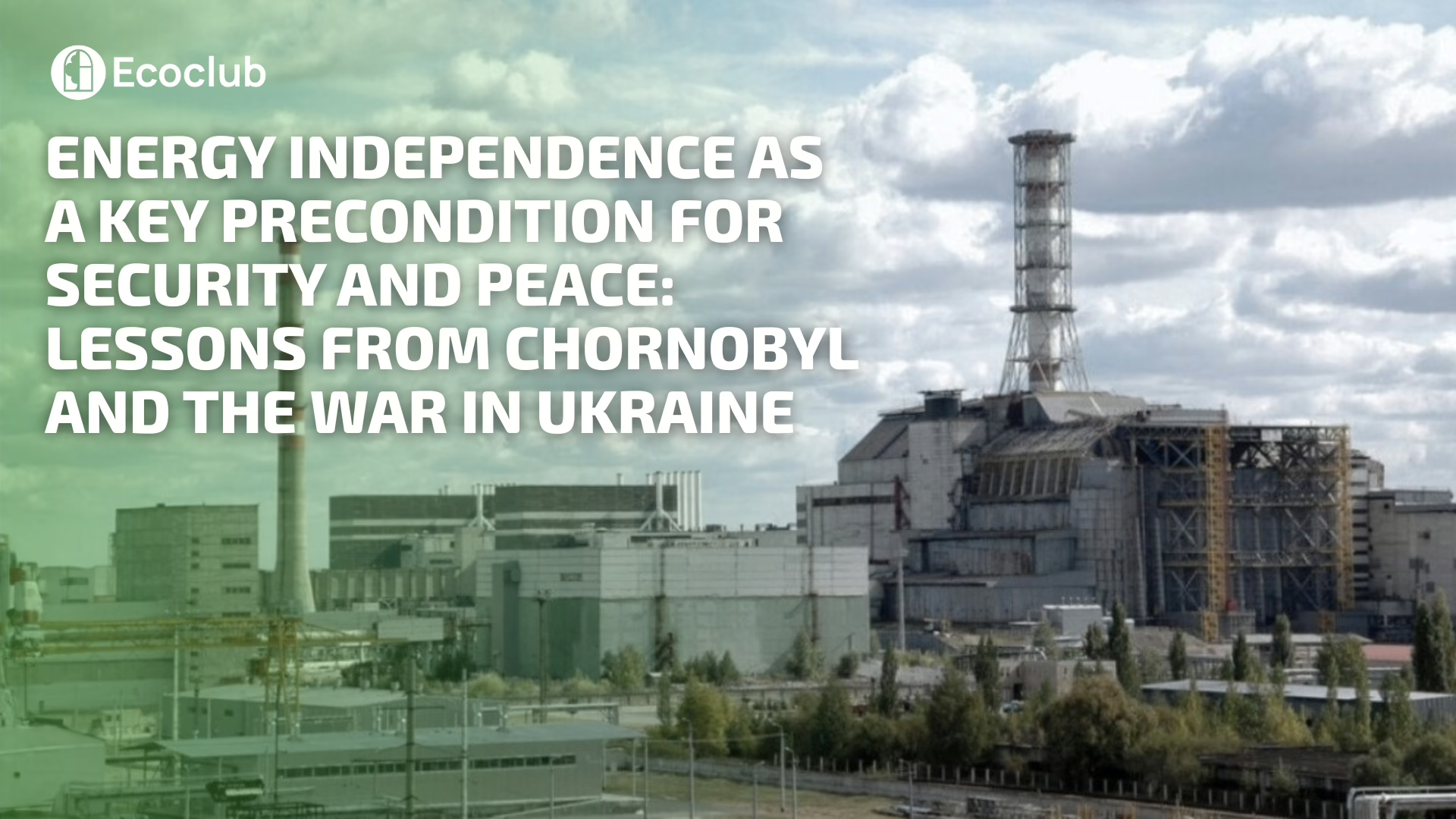
The 1986 Chornobyl nuclear disaster exposed the vulnerability of centralised energy systems: an entire country’s dependence on just a handful of strategic energy facilities. It stands as an enduring reminder that the price of a kilowatt can be measured in thousands of shattered lives, lost homes, and millions of hectares of land rendered uninhabitable for centuries. Today, this vulnerability has transformed energy from critical infrastructure into a strategic weapon. Where large energy hubs once carried the risk of technological disasters, in the conditions of modern warfare they have become priority targets for dismantling state resilience. The reliability of a modern grid rests on its ability to function under deliberate attack, not merely on generation capacity. We have reached a point where decentralisation and the technological transformation of energy grids are the only way to ensure state resilience. Ukraine’s nuclear power units are approaching the end of their operational life: of 15 reactor units, 12 have exceeded their original design lifetime, increasing the risk of emergencies.
War as a Catalyst of Awareness: Energy as an Instrument of Pressure
Russia’s full-scale invasion of Ukraine in 2022 showed that a country’s heavy reliance on nuclear energy can be turned into an instrument of geopolitical blackmail and international terrorism. Throughout 2022–2026, Russia has systematically attacked and continues to destroy Ukrainian energy infrastructure. According to World Bank estimates, a significant share of generating capacity and grid infrastructure has been damaged or destroyed, causing large-scale blackouts, with reconstruction costs estimated at $91 billion. At the same time, Europe’s pre-war dependence on Russian gas demonstrated how fossil fuels can be wielded as a tool of political pressure.
The occupation of the Chornobyl and Zaporizhzhia nuclear power plants, together with the destruction of the Kakhovka Hydroelectric Power Plant, created unprecedented risks for global security. The destruction of the Kakhovka HPP not only triggered an ecological catastrophe but also jeopardised the cooling system of the ZNPP – the largest nuclear station in Europe. According to the IAEA, the stability of the plant’s operation has repeatedly been threatened by critically low water levels in the reservoir and by the loss of external power caused by recurring shelling. Large centralised generation, once regarded as a guarantor of stability, has in wartime become a structural risk to national security. A single precise strike on a nodal substation or the occupation of a single station can paralyse entire regions. Building new reactor units during wartime does not solve the core problem of replacing destroyed generating capacity: construction takes years, costs are staggering, and the safety of such solutions for people and the environment raises serious concerns – a minor accident at a nuclear plant can escalate into a global catastrophe, as Chornobyl has already shown.
Energy Independence
For decades, the European and Ukrainian energy markets were built on the flawed assumption that Russian resources were cheap and reliable. Countries that depend on fossil fuel imports or maintain excessively centralised energy systems remain vulnerable to both external and internal threats. According to the International Energy Agency (IEA), fossil fuels sourced from autocracies – where all power is concentrated in the hands of one person – always carry a hidden premium in the form of political pressure and security risks. Russian aggression has proved that energy dependence is the foundation on which military expansion is built.
For Ukraine, the question of energy independence has shifted from the economic sphere into the sphere of survival. Today, energy independence is synonymous with national security. Every gigawatt-hour produced domestically from wind or solar is not merely a step towards climate goals but, above all, a reinforcement of sovereignty. Lasting peace will remain out of reach as long as the aggressor retains levers of energy blackmail over entire states.
Why Investing in Ukraine’s Decentralised Energy Is in the World’s Interest
The international community views support for Ukraine’s energy transformation as a far-sighted strategic investment that goes beyond ordinary solidarity.
First, decentralised solutions. Small generation facilities – rooftop solar installations on hospitals, energy cooperatives, and the like – are extraordinarily difficult targets for missile strikes compared with the vast turbine halls of thermal power plants and the infrastructure of nuclear stations. Even when individual components are damaged, the overall network continues to function.
Second, the speed of deployment for such solutions is significantly higher. Small renewable projects can be implemented within months, whereas large infrastructure facilities require years. Moreover, the cost of energy from renewable sources today is significantly lower than the cost of nuclear generation. Renewable energy facilities can be brought into operation in a matter of months – critically important in wartime, when every hour costs human lives.
At the same time, an equally pressing challenge is the responsible and safe decommissioning of nuclear power plants once they reach the end of their life cycle. This process is not a simple shutdown of a reactor; it is a complex, multi-year programme of engineering and environmental measures, including the decontamination of equipment and the safe handling of spent nuclear fuel. Establishing a clear decommissioning roadmap and securing the necessary funding ensures that the nuclear legacy will not become a burden on future generations.
Third, investments in renewables are aligned with the climate goals of the European Union, in particular the European Green Deal, which aims to make Europe the first climate-neutral continent by 2050 through a comprehensive overhaul of the economy that operates without harming the environment. Ukraine is already integrating into the European energy market, and the development of clean energy strengthens not only Ukraine but the European Union as well. The transition to renewable energy sources is also a key element in meeting the goal of limiting global warming to 1.5°C.
The Role of Civil Society: Ecoclub’s Experience
The role of civil society in the energy transition is decisive, and Ecoclub’s experience demonstrates how civic initiatives can become drivers of systemic change at the state level. For many years, the organisation has consistently worked on reforming the environmental impact assessment (EIA) process, advocating for transparent and sustainable decisions grounded in the principles of environmental safety. We actively advocate against outdated and unsafe energy projects while creating fertile ground for the development of renewable energy sources.
The project to complete Units 3 and 4 of the Khmelnytskyi Nuclear Power Plant is presented as a contribution to energy independence, yet it is accompanied by serious concerns regarding its implementation. The technical parameters of the project are shifting – in particular, the use of reactor types not covered in earlier environmental impact assessment materials is being considered. This means that previously conducted procedures may not reflect the actual risks. Implementing this project would push the European community even further from the potential benefits of a decentralised Ukrainian energy system.
Ecoclub provides comprehensive support for energy projects – from informing and training local self-government representatives in the field of energy efficiency to providing professional technical expertise at every stage of construction. We not only help to introduce modern management and technical solutions that transform local approaches to energy consumption, but also actively shape state policy. Through the analysis of and commentary on legislative acts, public statements, and advocacy campaigns, we work to ensure that the interests of communities and environmental standards are integrated into national development strategies.
Distributed generation makes it possible to supply electricity to hospitals, water utilities, and other critical infrastructure facilities even in the event of large-scale attacks on energy assets. It also builds long-term economic resilience at the local level. The most significant outcome of these years of work is the contribution to the resilience of Ukraine’s critical infrastructure. Thanks to the efforts of Ecoclub and its partners, 89 solar power plants have already been built in communities, ensuring the energy independence of hospitals and water utilities, and territorial communities (hromadas) are adopting their own energy development plans centred on sustainable solutions.
A telling example is the Teofipol hromada in Khmelnytskyi Oblast: after a solar power plant was installed on a local outpatient clinic in 2024, the savings it generated began to be channelled into new energy projects. The hromada is currently finalising the documentation for the installation of four more solar power plants – at educational institutions, a hospital, and a water utility.
Conclusion
The lesson of recent decades is simple: the vulnerability of an energy system always has a price – and that price rises together with the scale of the risks. Today, we count the losses not only in money. What is at stake is the safety of our families, the stability of our country, and the ability to plan for tomorrow. When all energy is concentrated in one place or depends on a single actor, sooner or later it becomes an instrument of pressure.
Decentralising the grid therefore means transitioning from an object of manipulation to an independent player that sets its own course of energy development. Such a system is able to withstand serious trials, recovers more quickly, and keeps working even in critical moments. It is precisely this path that will determine how secure and resilient our communities and the state as a whole will be in the future. At the same time, for international investors, governments, and donors, this means a clear choice. Supporting decentralised renewable energy in Ukraine means helping a country devastated by war – and it is also a contribution to global security, climate stability, and lasting peace.