












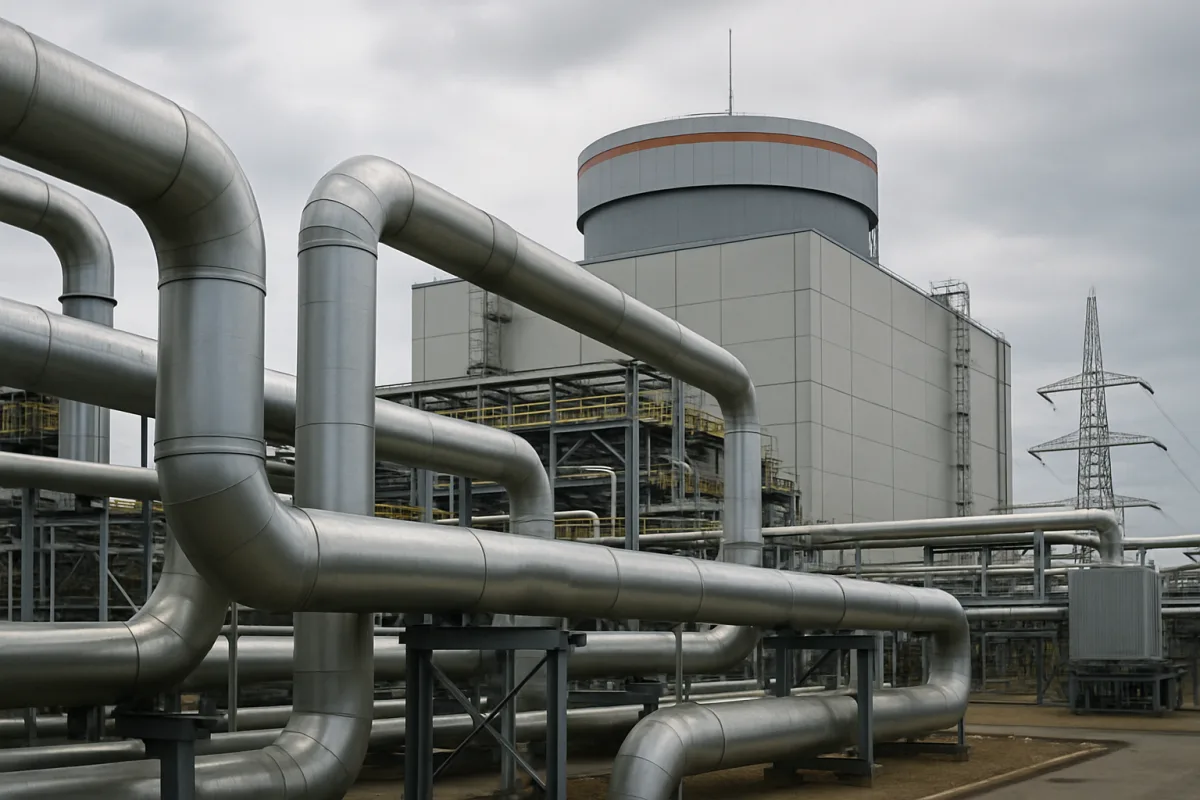
In September, Poland launched transboundary consultations with Ukraine on the environmental impact assessment of the construction and operation of up to four small modular reactors with a total capacity of up to 1300 MW in the city of Stalowa Wola, approximately 100 km from the Ukrainian–Polish border. Meanwhile, draft law No. 14164, intended to pave the way for such reactors in Ukraine, awaits consideration in the Verkhovna Rada.
What are small modular reactors (SMRs), what are the promises of lower costs based on, which safety questions remain open, and what concerns does the Ukrainian draft law raise? Let us consider these questions in turn.
What SMRs are and how they work
In a nuclear reactor, a controlled chain reaction of uranium fission releases heat. This turns water into steam, which drives a turbine to generate electricity. SMRs operate on the same principle as reactors at a large nuclear power plant; the differences lie in scale and configuration.
According to the IAEA, a small modular reactor has an electrical capacity of up to 300 MW per unit1. That is approximately one third of the capacity of a typical reactor at a large nuclear power plant, which produces 1000 MW or more. However, the threshold is flexible: the British Rolls-Royce SMR has a capacity of 470 MW, the American Natrium has a capacity of 345 MW, and both are presented as SMRs.
The term “modular” refers to the approach to manufacturing: key reactor components are manufactured at a factory, delivered to the site as finished components and assembled as modules.
An important qualification: SMRs are not a single technology but an umbrella term for dozens of different reactor designs. According to the OECD Nuclear Energy Agency (NEA), there are 127 SMR designs worldwide. Of these, 74 have been analysed in detail. And only seven are operating or under construction.
Some SMRs are scaled-down water-cooled, water-moderated reactors, related to those operating at Ukrainian nuclear power plants. Others use liquid sodium, lead, molten salts or gas. Differences in coolant, fuel and the physical principles of operation also mean differences in risks.
What problems do SMRs promise to solve?
Interest in SMRs stems from the problems of large nuclear power plants: high costs and lengthy construction. Examples include Vogtle in the United States, Flamanville in France and Hinkley Point C in the United Kingdom. Years of delays to these projects have been accompanied by costs rising to several times the original estimates. For investors, this means funds tied up for a long time and uncertainty over the final costs.
SMR developers propose a different model and promise the following advantages:
- Lower initial investment: building individual modules in place of a single large unit.
- Series production in factories and repeatable designs in place of one-off construction.
- Gradual increases in capacity in line with demand and available financing.
- Production of electricity as well as heat for industrial processes.
From designs to construction: examples
There are dozens of SMR projects worldwide, yet only a handful of facilities have been completed so far. It is therefore important to distinguish between announced plans, preparatory work, construction and commercial operation of reactors.
For example, GE Hitachi is building the BWRX-300 at the Darlington site in Canada: the first Western SMR to reach the construction stage.
In the United Kingdom, the Rolls-Royce SMR has been selected for the programme, though it has yet to be built.
TerraPower is building the non-nuclear part of the Natrium plant in Wyoming, United States, while awaiting fuel.
Thus, based on the information presented, as of 2025–2026 there is still no commercial SMR project with proven series production of low-cost electricity. The most optimistic timeframe for mass deployment is the early 2030s. The EU SMR Strategy also aims for this period, provided that the planned steps are carried out.
SMR economics: relying on series production
The economic model for SMRs relies on series production, whereas large nuclear power plants rely on the scale of individual units. At large plants, greater capacity makes it possible to reduce costs per unit of capacity. The SMR approach is different: identical units are expected to become cheaper and quicker to build through repeated use of the same design and accumulated experience, the so-called learning curve.
However, the anticipated savings have yet to be demonstrated in practice. Two concepts are important here:
- FOAK — “first of a kind”. The first example of a new technology is expensive: production is still being established, and mistakes are being corrected.
- NOAK — subsequent units in a series. They are expected to cost less thanks to established production processes and accumulated experience.
To move from an expensive first unit to a cheaper series, a substantial order book for a single design is needed. This creates the main trap: investors expect a low price before ordering SMRs, yet that price may never materialise without mass orders.
A further problem is market fragmentation. If orders are spread across dozens of different designs, none may receive a large enough production run to achieve the expected cost reductions. This is precisely why many independent analysts doubt that the promised savings will materialise.
Safety: smaller does not mean safer
SMR proponents emphasise their smaller reactor cores, lower heat inventories and passive cooling systems. Such systems use natural physical processes and do not rely solely on pumps that need electricity. For some water-cooled, water-moderated designs, this may be an advantage compared with older plants.
However, reactor size alone does not guarantee safety. Three issues need to be distinguished.
The first is the scale and nature of the risk. A smaller reactor does not automatically eliminate the risk of an accident. It changes the nature of that risk.
The second is the specific characteristics of the technology. Non-water-cooled designs — sodium-, lead- and molten-salt-cooled — require a separate assessment of hazards associated with coolants, limited operating experience and fewer data on failures.
The third is maturity and independent review. Many designs have yet to undergo a full independent assessment and certification procedures. German experts, in particular, have publicly questioned the economic viability of the SMR-160 proposed for Ukraine and pointed to the absence of an international certificate.
IAEA and Euratom standards do not provide separate, less stringent rules for SMRs. The same nuclear safety requirements apply to them as to large reactors, taking into account the risk posed by the specific installation. Thus, lower capacity does not mean a lower safety threshold.
Sites, security and emergency planning
Locating many small reactors at different sites means more security perimeters and emergency planning zones. Each facility requires maintenance and protection to equally high standards. SMRs can also be located in groups: several modules at one site, as in the Polish BWRX-300 project or Canada’s Darlington project, provide capacity comparable to that of a conventional nuclear power plant. The advantages of distributed siting should therefore be assessed alongside the additional security and emergency planning requirements.
Fuel: the risk of a new dependency
Fuel and radioactive waste are critically important issues for Ukraine. One of the key risks concerning fuel is dependence on suppliers.
Scaled-down water-cooled, water-moderated SMRs can run on conventional low-enriched uranium — around 5% uranium-235, as at operating Ukrainian plants. A significant proportion of other designs require HALEU — uranium enriched to between 5% and 20%. According to the estimate cited, the Russian company Tenex remains effectively the only producer of HALEU in industrial commercial volumes. The United States began demonstration production at the Centrus plant in 20239.
For Ukraine, which seeks to rid itself of dependence on Russia in the nuclear sector, this is a fundamental issue. The choice of technology could replace one dependency with another. This is not automatically an argument against SMRs, but the reliability and independence of the fuel supply should be assessed at the beginning, rather than the end, of the decision-making process.
Ukraine: plans and draft law No. 14164
Energoatom has agreements on SMRs with Holtec (SMR-160), NuScale, Westinghouse (AP300) and Rolls-Royce. Ukraine has also proposed the Chornobyl Exclusion Zone as a potential site. However, these are mostly memoranda and the exploration of possibilities, rather than construction already under way.
In autumn 2025, draft law No. 14164 on the principles for deploying SMRs was registered in the Verkhovna Rada. The relevant committee recommended adopting it as a basis for further work[12]. The document addresses issues beyond technical procedures. It changes the decision-making process for nuclear facilities. These changes are precisely what raise concerns among the NGO Ecoclub and other energy experts.
The main concern is the proposal to create a special legal regime for SMRs with a number of exemptions. This is contrasted with the approach taken by EU law and IAEA standards: common nuclear safety requirements are applied based on the risk posed by the specific installation, rather than its type or size alone.
The EU is considering accelerated and coordinated licensing through the SMR Strategy and the Industrial Alliance. This work would take place within existing safety rules, without lowering requirements. The concern about the Ukrainian draft law is that the acceleration of procedures is not accompanied by equivalent safeguards.
The authors of the draft law also propose exempting nuclear power plants with SMRs from the separate law governing decisions on nuclear facilities of national significance and transferring the authority to grant construction permits to the Cabinet of Ministers.
A shift to government decisions does not in itself run counter to European practice. In France, the government grants authorisation to create a nuclear installation. In Poland, the relevant minister makes the decision in principle. However, this model provides for checks and balances: an independent regulator, an environmental impact assessment (EIA) with an analysis of alternatives, public hearings and debates, and the possibility of a legal challenge.
By contrast, as the concerns outlined here suggest, draft law No. 14164 removes parliamentary oversight and narrows public participation without equivalent compensating mechanisms. The narrowing of public participation also requires a separate assessment of compliance with the Aarhus Convention.
In addition, the draft law proposes removing the requirement to consider at least three alternative sites for reactor construction, which conflicts with IAEA principles for safe site selection.
For Ukraine, this issue is especially important because of proposals to locate SMRs on the sites of old thermal power plants. Existing infrastructure alone does not demonstrate that a site is suitable for a nuclear facility. Nuclear safety and physical protection, emergency planning and the availability of water resources, as well as resilience to enemy strikes in wartime, need to be assessed.
An analysis of alternatives makes it possible to weigh these risks before construction begins
The draft law also provides for the possibility of private ownership of nuclear fuel for commercial SMRs. At the same time, Article 86 of the Euratom Treaty establishes Community ownership of fissile materials, including enriched uranium and plutonium. Upon Ukraine’s accession to the EU, this provision will also apply to Ukraine.
The Euratom model does not prevent private financing. The argument that private ownership of fuel is needed to attract investment can therefore be questioned. The draft law contains no transitional provisions to resolve this conflict.
Another concern relates to the proposal to replace the requirement for a permit to decommission a reactor with a notification procedure. This is viewed as a weakening of state oversight at one of the riskiest stages in an installation’s life cycle.
A separate risk is that the exemptions are linked to the capacity of an individual module, with the capacity of the entire facility left out of account. Under this approach, a large nuclear complex can formally be divided into “small” units to which the general procedure would not apply when considered individually. This is the problem of project fragmentation.
Finally, the draft law does not address workforce training or the regulator’s capacity to assess new reactor designs and oversee their safety. The European SMR Strategy places particular emphasis on training specialists and regulatory capacity. Without these, introducing a technology that is new to the country creates additional risks.
Overall, before making decisions on large-scale investment in SMRs, Ukraine should compare the full cost of such projects, construction timelines, risks and expected returns with the opportunities already offered by renewable energy and energy storage systems. There is no certainty that the balance will tip in favour of nuclear energy.
This material was produced with the support of the Heinrich Boell Foundation, Kyiv Office – Ukraine. Heinrich Boell Foundation, Kyiv Office – Ukraine bears no responsibility for its content.
