












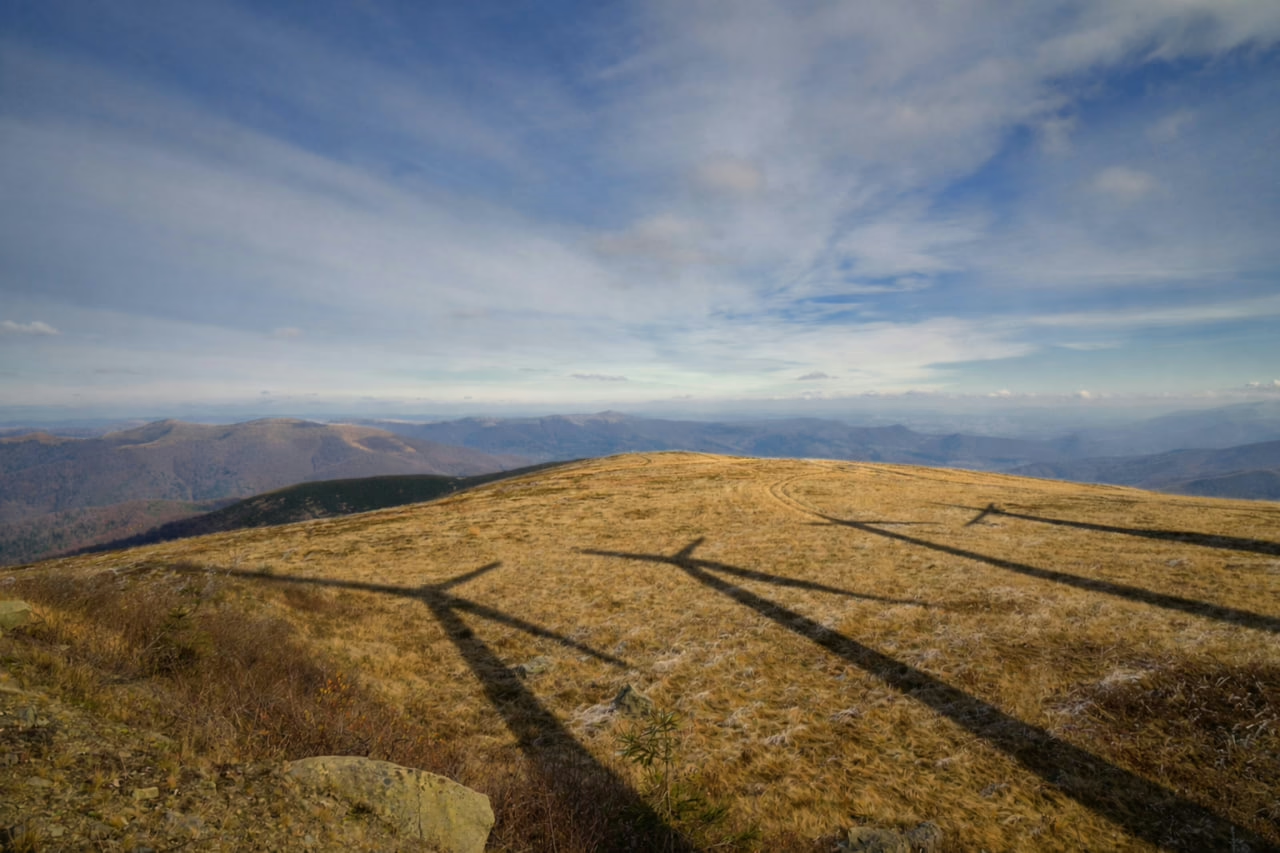
The year 2026 has just begun, and events surrounding the wind power plant (WPP) in Polonyna Runa have already become the focus of civil society. This case has revealed systemic violations that threaten the preservation of the unique high-mountain ecosystems of the Carpathians. This story goes far beyond the installation of wind turbines in the highlands. It is a fundamental principle: does the state have the right to give the green light to a project when the environmental impact assessment (EIA) procedure becomes a formality full of contradictions?
How it all began
The history of wind turbines in Polonyna Runa began in 2022, the first year of full-scale war. Due to hostilities in the east of the country, the large wind turbine manufacturing company Management Company Vitrovi Parky Ukrainy LLC moved to Transcarpathia. The company immediately announced ambitious plans to build up to a hundred wind turbines in the region within a few years. The first such wind turbine was launched in Nyzhni Vorota in early 2024. Details.
The was Polonyna Runa in the Uzhorod district. The land belongs to the Turye-Remetivska hromada, a district that has not seen significant investment or development for years. The developer promised the community 45 million hryvnias annually to the local budget and social assistance: road repair and renovation of the local school. Details.
However, with the legal support of the project, everything did not go according to plan. In June 2024, the company VITRYANY PARK TURYANSKY LLC officially began the environmental impact assessment (EIA) procedure. The main idea behind this procedure is simple: first, the state and the people study whether the wind turbines will harm nature, and only then do they give permission for construction. EIA is a safeguard to prevent irreparable damage.
But the developer decided not to wait. While in January 2025 the official review of documents was suspended due to court proceedings, equipment. Was already operating on the mountain pasture. The State Environmental Inspection officially recorded that the company had begun removing fertile soil and building roads even before receiving permission (Order No. 012/04 of June 23, 2025). Details.
The entire period from 2024 to 2025 and the beginning of 2026 was accompanied not only by a purely administrative process, but also by a wave of public resistance. Environmental organizations, scientists, and local residents joined forces in the fight to preserve the highlands. Petitions to the authorities, hundreds of appeals, expert comments on the EIA report, and numerous posts on social media clearly articulated the position: the highlands are not a place for industrial facilities.
Release of the conclusion and public reaction
On February 13, 2026, the Ministry of Economy, Environment, and Agriculture of Ukraine (hereinafter referred to as the Ministry of Economy) officially announced its conclusion on the environmental impact assessment regarding the admissibility of constructing a wind farm on Polonyna Runa. This decision immediately sparked a new wave of debate, becoming one of the most discussed events in the environmental sphere. Despite the ministry’s assurances that the construction project complies with regulations, a detailed analysis of the documents reveals contradictions that can hardly be called insignificant.
The position of the state on this issue was explained by the Minister of Economy, Environment, and Agriculture of Ukraine, Oleksiy Sobolev. According to Sobolev, experts conducted a “thorough” analysis: the territory is not part of nature reserve, and the construction does not involve deforestation, as it will use the infrastructure of a former military facility from the 1960s.
“We understand the concerns of environmental organizations… however, there are currently no legal grounds for declaring the activity unacceptable,” said Oleksiy Sobolev, adding that the investor is responsible for installing bird repellent system and changing the route of roads to preserve rare newts.
However, this explanation is precisely where the main stumbling block lies. The Ministry of Economy has acknowledged that the developer is using the tactic of “salami slicing” (gradually breaking down the project into smaller parts to avoid an assessment of the impact of the entire facility). Oleksiy Sobolev directly confirmed that the ministry does not support such practices, as they “create the risk of circumventing environmental procedures.” Moreover, the Ministry of Economy is already initiating changes to the legislation to prevent such schemes in the future. Details.
Why a refusal should have been issued in this situation
According to Part 7 of Article 9 of the Law of Ukraine “On Environmetal Impact Assessment”, the state must declare an activity unacceptable if, even after all protective measures have been taken, the damage to nature remains so great that it directly violates the law. In the case of Polonyna Runa, there were clear legal grounds for such a decision.
There are several circumstances here that call into question the admissibility of the project. First of all, construction began in violation of urban planning legislation. The work was justified by registering notifications of the start of construction of only individual elements, such as the foundation for the wind turbines. At the same time, the impact class of the facility was artificially lowered to “insignificant” (CC1). However, given their scale and risks, the foundation of huge turbines cannot belong to this category. The classification of turbine foundation as CC1 is unlawful, as this class is intended for low-risk facilities (e.g., farm building or temporary structures). Given the enormous height of the structures, dynamic wind loads, and high cost of equipment, such facilities pose significant risks to the environment and people in the event of an accident, which meets the criteria for class CC2 or even CC3. (Details). This underestimation allowed construction to begin under a simplified procedure without the proper permits, which has all the hallmarks of unauthorized construction.
The EIA law clearly states that the assessment must take place before work begins, as its purpose is to prevent harm, not to record it. However, the construction of roads and foundations began before the EIA procedures was completed. This has already had a negative and irreversible impact on the air, soil, water, flora, and fauna of the mountain system. Since the damage has already been done, it is simply impossible to determine measures to prevent it within the EIA procedure.
Despite the fact that the Ministry of Economy did not recognize this planned activity as unacceptable, the question arises: why was the EIA conclusion not refused? After all, the existence of factual inconsistencies and the provision of unreliable information by the business entity is a legal basis for such a decision.
Contradictions in the report: what exactly does not add up
The decision on the admissibility of the construction of the wind farm is based on the EIA report and other additional information obtained during the procedure. However, if we put aside the official press releases and delve into the details of the documentation, it becomes clear that the project was given the green light despite serious gaps in the environmental studies. The report contains a number of statements that directly contradict both the actual state of affairs on the Runa mountain pasture and the requirements for objective scientific analysis. Here are the key points where the developer’s figures and forecasts diverge from reality:
- Unreliable, conflicting information in the project description
The EIA report states on page 17 that there are no buildings or structures on the land plots. However, other documents related to the same project indicate that the construction of foundations for wind turbines has already begun there. We see an obvious distortion of reality: the developer provides information about empty plots, deliberately ignoring the construction processes that have already begun on the mountain pasture.


Therefore, the information in the EIA report is unreliable and contradicts the additional information provided by the business entity.
- Unreliable, contradictory information on noise impact assessment
Noise calculations deserve special attention, as they are usually one of the most important factors of the negative impact of wind turbines on the environment. In the report (Appendix 27), these calculations were used as a basis for the statement that the wind turbines will generate an acceptable level of noise. However, the figures in the calculations do not match the actual characteristics of the wind turbines themselves.
According to the report (p. 7), the height of the wind turbine tower should be 100 meters, and the diameter of the rotor should be 151 meters. However, in the Appendix No. 27, which directly calculates the noise level for individual wind turbines (No. 13, 17-20), completely different parameters are used: the tower height is 140 meters and the rotor diameter is 160 meters. Since the noise level of the station directly depends on the size of the tower and blades, such inconsistencies cast doubt on the main conclusion: will the noise from the wind farm really be within the norm?

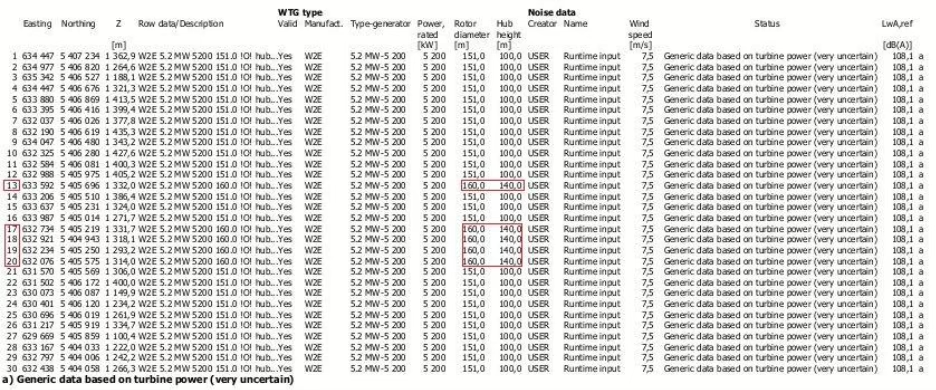
Another significant inconsistency arises when comparing the main text of the report with its technical appendices. The distance from wind turbines to recreational areas (places of rest) is crucial for calculating noise levels: the closer the wind turbine, the louder it will be for people. However, the data in different parts of the documentation “diverge” by tens, and sometimes hundreds, of meters.
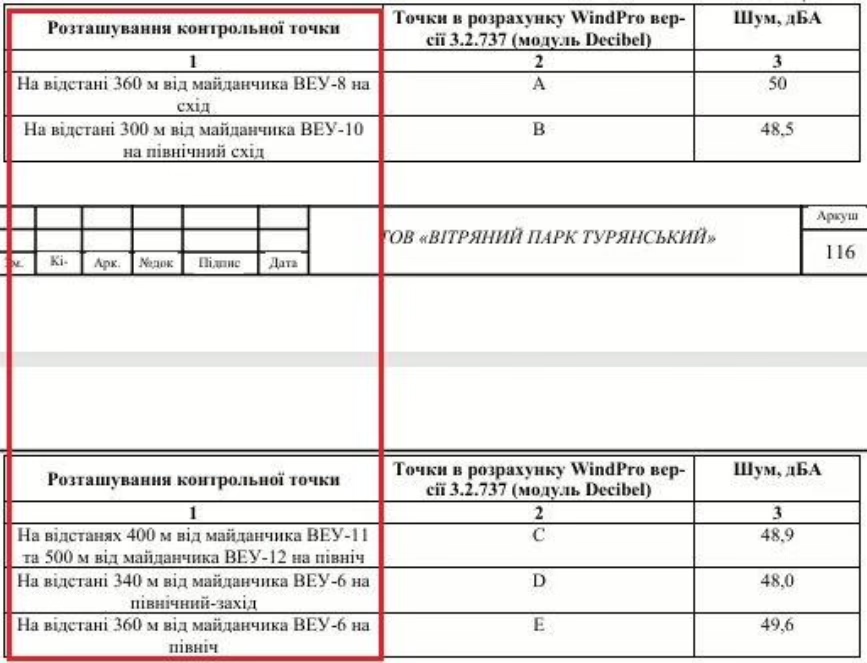
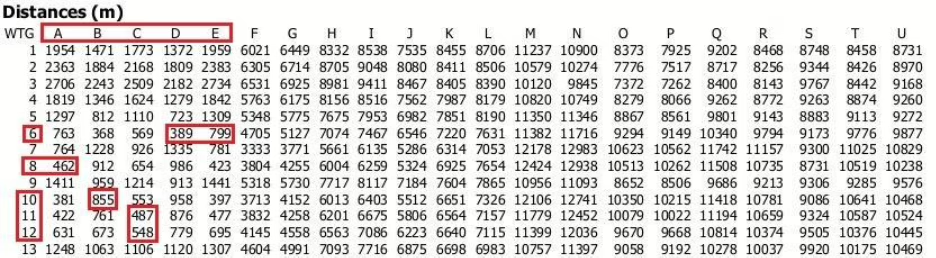
For clarity, we compared the figures from the main text (Articles 116-117) with the specialized WindPro program calculation contained in Appendix 27.
| № WT | Marking of points according to WindPro version 3.2.737 | Distance according to Table 42 of the EIA report | Distance according to WindPro version 3.2.737 (Appendix 27 of the EIA report) | Difference between distances |
| 8 | A | 360 м | 462 м | 102 м |
| 10 | B | 300 м | 855 м | 455 м |
| 11 | C | 400 м | 487 м | 87 м |
| 12 | C | 500 м | 548 м | 48 м |
| 6 | D | 340 м | 389 м | 49 м |
| 6 | E | 360 м | 799 м | 439 м |
The existence of such significant differences in the figures indicates that either the main text of the report of Technical Appendix 27 contains inaccurate information. When the data on distances and technical parameters of wind turbines contradict each other, noise calculation become meaningless. This means that the real impact of the station on people and the environment remain unverified.
- Assessment impact on soil
Discrepancies in the documentation concern not only noise or waste calculations. The issue of land use and protection of highlands is even more significant, as it shows the true scale of the transformation of Polonyna Runa.
According to the report (p. 96), the project involves changing the designated use of almost the entire area under consideration by the developer. Of the total area of 18 hectacres allocated for the wind farm, the change of designated use if planned for 15.99 hectares. This means that a huge part of the mountain landscape will effectively lose its natural status and be transformed into an idustrial site due to the fragmentation of construction. This process divides intact ecosystems with a network of roads and fences, creating insurmountable barriers for wildlife, disrupting natural drainage, and transforming once-wild mountains into fragmented technical zones.
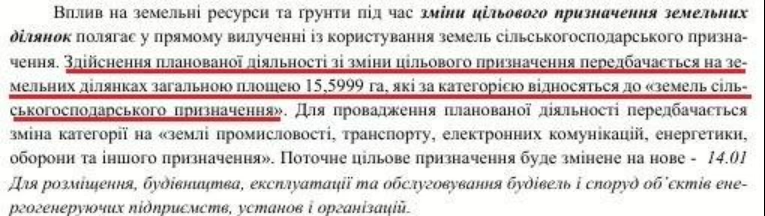
On page 101 of the EIA report, the developer only calculates the volume of soil that it “plans” to remove. However, additional materials for the same project indicate otherwise: the construction of foundations for nine wind turbines has already begun on the plateau.
Considering that the area under one such installation is about 0.6 hectares, the total area of intervention has already reached 5.6 hectares. This means that the calculations in the EIA report are meaningless, as they describe future actions that have already taken place. This is direct confirmation that construction began before the official procedure was completed. In particular, this applies to the change in the intended use of agricultural land. The law clearly prohibits such activities until an EIA conclusion has been obtained. Thus, the report itself documents the violation by recording the start of work on the mountain pasture without proper grounds.

- Unreliable, contradictory information regarding waste management assessment
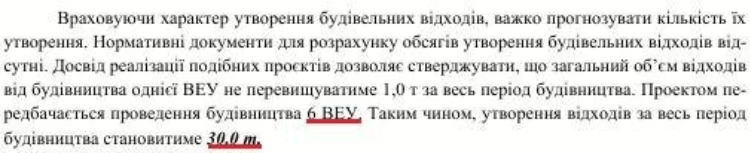
Another contradiction concerns construction waste (p. 59 of the report). The developer indicates that 30 tons of construction waste will be generated during the works. This amounts to 1 ton per wind turbine. However, the report mentions the construction of only 6 such turbines. It remains unclear where the remaining 24 tons of waste will go or where the figure of 30 tons came from.
In addition, inaccuracies were found in the calculations of household waste (p. 60 of the report). The developer claims that 51,781 tons of household waste will be generated during the entire construction period. However, a realistic calculation based on the project data itself gives a completely different result. Taking into account the number of employees (50 people), the waste rate (350 kg per year), and the duration of construction (just over 3 years), the result is more than 53 tons of waste.
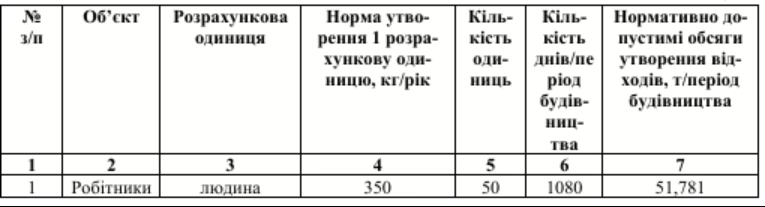
1080/356=3.033 years (construction duration).
350*50*3.033=53 077 kg/during construction, which is 53.077 tons/during construction.
Such discrepancies in calculations indicate certain technical inaccuracies in the report. This raises questions about the thoroughness of the documentation and highlights the need for more rigorous verification of environmental forecasts, on which the safety of the entire project depends.
A dangerous precedent: why the case of Polonyna Runa concerns everyone
Summarizing the analysis of the EIA report, we conclude that the document contains significant discrepancies and factual errors that cannot be ignored. Inaccurate technical parameters of wind turbines, incorrect calculations of distances to recreation areas — all this leads to a distorted environmental impact assessment procedure, as a result of which the real risks to nature and people remain unassessed.
Most importantly, the EIA report actually documented a direct violation of the law: the start of foundation construction before the procedure was completed. This turns a preventive environmental protection tool into a formality that presents a fait accomplished. Allowing construction based on such unreliable data will create a dangerous practice of applying the procedure and pave the way for the gradual destruction of other valuable ecosystems.
In this case, we see a paradoxical and alarming situation: the state effectively recognizes procedural manipulations that discredit the EIA for the public and business but issues a conclusion on the admissibility of the planned activity, appealing to the absence of direct prohibitions in the current law. Our view of the situation is clear: this approach turns the Polonyna Runa case into a dangerous signal for society as a whole.
The development of renewable energy is strategically necessary for Ukraine, especially in the context of the current energy crisis. However, the path to energy independence cannot lie in the destruction of mountain ranges and the disregard of legal procedures.