











Slavuta has been advancing energy efficiency for over a decade – implementing energy monitoring, modernising municipal infrastructure, installing solar power plants at critical infrastructure facilities, and developing financial mechanisms for its residents.
The community is located in Shepetivka Raion of Khmelnytskyi Oblast and has a population of around 35,000 people.
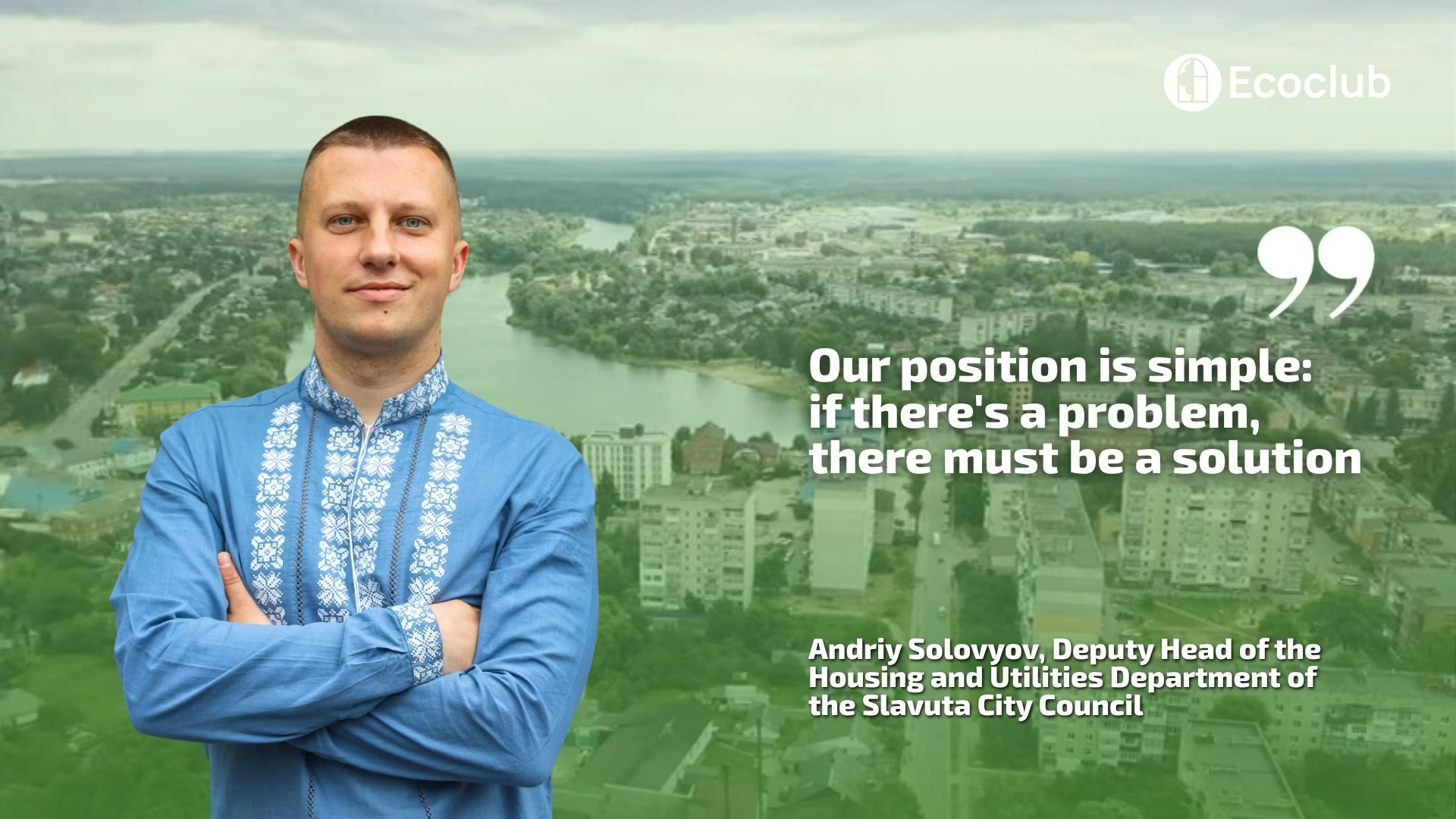
Andriy Solovyov – Deputy Head of the Housing, Communal Services, and Infrastructure Department of Slavuta City Council, responsible for energy management and project development – shares how Slavuta is moving toward energy resilience, why it partners with condominiums (OSBBs), and how training from Ecoclub helped reshape their financial tools.
Sustainable Development in the Community
Slavuta community has been working on sustainable development for over ten years. The direction gained momentum after the launch of decentralisation reform in 2015, when communities gained greater scope to plan their own development independently.
The focus starts with what directly affects people’s lives: heating networks, street lighting, water supply, and public amenities. Energy efficiency is a particular priority – it helps the community consume fewer resources and develop more steadily.
In January and February of this year, critical infrastructure facilities in the community experienced over 700 power outages. There were instances where the hospital, the water utility (vodokanal), and the city’s largest boiler houses were without electricity for more than eight hours.
“For us, energy resilience is not an abstract goal – it is a question of whether basic services can function even during blackouts,” says Andriy Solovyov.
How Energy Management Works
The community’s energy management system has been running for over ten years. They use their own product, “Energobalance,” which tracks energy resource consumption across municipal institutions. Every facility has a designated responsible person who enters data into the system. This allows the community to see where overconsumption occurs, where problems arise, and where energy-efficient solutions can be introduced.
Staffing proved to be one of the key challenges in this area. When Slavuta won a World Bank grant to install a gas-fired cogeneration unit and build its own power grids for critical infrastructure, it became clear that the project required experts the city did not have. In such cases, the community council recommends bringing in external specialists.
Strategic Documents
The community has a Sustainable Energy Development Action Plan. There is also an active energy resilience and energy production programme – the one that drives solar power plant projects for the hospital, the Administrative Services Centre (CNAP), and the water utility.
A separate programme for the reform and development of housing and communal services has also been established. It covers municipal enterprises but also incorporates energy efficiency and energy resilience measures, including the introduction of alternative generation sources.
The community will additionally develop a Municipal Energy Plan, as required by law. At the same time, Slavuta insists that every document must be a working tool that moves things forward – not a formality.
How Ecoclub Training Helped Reshape Financial Tools
When the community submitted its concept for Ecoclub’s project “Strengthening Climate Actions in Ukrainian Communities,” they initially set out to cover several directions at once: condominiums, the residential sector, and businesses. The thinking was that UAH 400,000 would be enough to support various groups. During the training, it became clear that spreading resources thin was counterproductive – the mechanism needed to be more targeted and tied to real needs.
“We realised that under a limited budget, it is important not only to provide funding but also to encourage residents to use other support programmes – specifically the Energy Efficiency Fund’s ‘Enerhodim’ and ‘GreenDIM’ programmes,” says Andriy Solovyov.
Why Previous Tools Did Not Work
The community already had revolving funds for the residential sector and condominiums, but people barely used them. One reason was a cumbersome and inconvenient procedure.
Formally, funds could be borrowed for a year. But because they were channelled through a municipal institution and tied to the fiscal year, in practice the term could be far shorter. If a resident or a condominium association received funds in June, the full amount had to be returned by December.
For energy efficiency projects, this is impractical: time is needed for preparation, procurement, completion of works, and expenditure planning. So, the community began looking for a different approach. Through partnerships and dedicated programmes, the mechanism is now being improved to give people a full term to use the funds.
Why the Community Works with Condominiums (OSBBs)
The housing stock in Slavuta is quite old. Many buildings are over 50 years old, need repairs, and residents cannot always afford the cost of expensive works on their own.
That is why working with condominiums has become an important priority. Some programmes grew out of residents’ own initiative. People who left property management companies and established OSBBs began approaching city authorities to raise the problems of their buildings.
This gave rise to a dedicated programme for such condominiums. The local government has already provided funding for routine repairs on several occasions and plans to offer similar support this year.
“Now we want to go further – not just help with routine repairs but also steer condominiums toward participating in larger energy efficiency programmes. We have chosen ‘Enerhodim’ as our priority. If residents are ready to participate, the community can step in and cover up to 10% of the cost,” explains Andriy Solovyov.
In Slavuta, local support is not viewed separately from state or international programmes. On the contrary, the aim is for these opportunities to complement one another. For example, a condominium can receive primary support through “Enerhodim” or “GreenDIM,” while the city additionally offsets a portion of the costs. This reduces the financial burden on residents and makes participation in the programmes more viable.
Two condominiums have already expressed interest in trying “GreenDIM.” They want to secure electricity supply for two lifts, lighting, and the boiler house circulation pumps in the event of blackouts.
Solar Power Plants for Critical Infrastructure
A key area of work in Slavuta is solar power plants (SPPs) for critical infrastructure. The community’s first such project was implemented together with Ecoclub: an SPP with backup batteries was installed at the hospital.
Later, a 140 kWp solar power plant was installed at the water utility, and another at the local Administrative Services Centre. The community also received equipment for the hospital worth approximately UAH 1.5 million: a 50 kWp SPP and 62 kWh of battery storage.
Integrating such solutions into a single system is essential, because even 100 kW of capacity is not sufficient for the hospital. During peak demand, its consumption can reach around 220 kW – which is why these projects need to continue and scale.
Advice for Other Communities
Slavuta emphasises that, above all, political will comes first. If the mayor understands why this matters and brings that message to council members and the community, the process moves forward much more smoothly.
At the same time, even with the backing of local authorities, a great deal of explanation is needed. Not everyone immediately understands why local government should get involved in condominium issues. But when you explain that these buildings are 50–70 years old, that residents cannot always afford expensive works on their own, and that without support the housing stock will deteriorate – attitudes change.
“It is important to show that this is not about simply ‘giving someone money.’ It is about solving a problem together. If buildings become more energy-efficient and resilient, it is a gain not only for the residents of that specific condominium, but for the entire community,” explains Andriy Solovyov.
Another piece of advice: learn from others. In Slavuta, they recall being particularly inspired by the experience of other communities following Ecoclub study tours to Lutsk, Rivne, and Kostopil. Seeing it work elsewhere makes it far easier to explain why it’s worth trying.
“Our position is simple: if there is a problem, there must be a solution. It will not always be perfect the first time – but you have to start,” he concludes.
The project is supported by the IKI Small Grants Program, which is part of the Climate Protection Initiative (IKI). IKI Small Grants is funded by the German Federal Ministry for the Environment, Climate Action, Nature Conservation, and Nuclear Safety (BMUKN) and the Federal Ministry for the Environment (AA), and is implemented by the Deutsche Gesellschaft für Internationale Zusammenarbeit (GIZ) GmbH.